
Lease Commencement Date: How It Differs From Rent Commencement, Inception and Execution
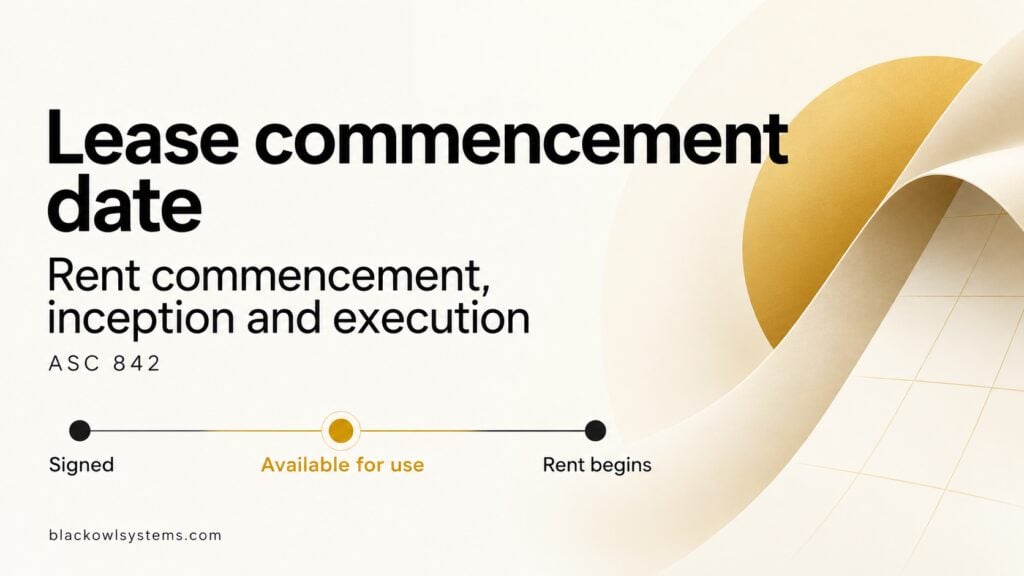
The lease commencement date is the day the lessor makes the underlying asset available for the lessee to use. That is when recognition begins and the opening right-of-use asset and lease liability are established. Other dates appear throughout a lease, but none determines when the accounting starts.
What is the commencement date in a lease?
For accounting purposes, a lease commences when control of the asset passes to the lessee. ASC 842-10-55-19 defines commencement by reference to when the lessor makes the asset available for use. The test concerns availability, rather than when the lessee moves in or begins paying rent.
With Black Owl Systems, consistent date capture supports lease management and accounting implementation services. The same records can support reporting under IFRS 16 and ASPE 3065.
The lessee has control once it can direct the asset’s use and obtain the benefits from it. A tenant receiving the keys to an empty shell has control even when another three months of fit-out work remain before move-in. A tenant waiting for the previous occupant to vacate does not yet have that control.
Several measurement decisions depend on this date. The discount rate must be the rate in effect at commencement, the lease term begins then, and the payment stream is discounted back to that point.
ASC 842 brought leases onto the balance sheet using commencement as the starting point for recognition.
What is the commencement of a lease?
Commencement marks the beginning of lease accounting, which can occur well after the contract itself takes effect. An agreement may be legally binding for months before the asset becomes available. During that interval, the lease exists as a legal arrangement without appearing on the balance sheet.
That interval accounts for most commencement-date errors. The signature date is easy to locate on the document, so preparers use it without establishing when control actually transferred. Signing and commencement rarely fall on the same day.
What is the difference between a commencement date and a start date?
A typical commercial lease refers to six dates. Each serves a purpose, but only the commencement date triggers recognition.
| Date | Meaning | Where to look in the lease | Does it begin recognition? |
|---|---|---|---|
| Inception date | The parties reach agreement on the principal terms | Term sheet or letter of intent | No |
| Execution date | The agreement is signed | Signature page | No |
| Effective date | The contract becomes legally binding | Opening recitals | No |
| Commencement date | The lessor makes the asset available for the lessee’s use | Delivery or possession clause | Yes |
| Rent commencement date | The first rent payment falls due | Rent clause or payment schedule | No |
| Possession or occupancy date | The lessee physically takes up the premises | Delivery clause or side letter | No |
Inception is most often mistaken for commencement. Agreeing to the principal terms establishes inception; obtaining control establishes commencement. Several months may separate those events.
Another frequent mistake is to use rent commencement. A landlord may grant a free-rent period after handing over the premises, allowing control to pass well before payments begin. The right-of-use asset is recognized during that interval because accounting follows control, not the movement of cash.
Starting the schedule when rent becomes payable excludes those free months. Both the asset and the liability are understated, and straight-line expense is distorted. The resulting difference between payment timing and expense recognition is one reason the commencement date needs separate attention.
Execution and effectiveness concern the contract’s legal status. Signing creates the legal obligation, while the effective date starts the contractual clock. Neither event, by itself, transfers control of the asset to the lessee or starts recognition.
When the lease is signed before the premises are ready
Signing several weeks or months before delivery is normal in commercial leasing. The accounting question throughout that period is when the lessee gains control.
Moving into the premises provides evidence of control, but occupancy does not define it. A tenant may already control a space while preparing it for occupation. Once the landlord hands it over for the tenant’s fit-out, control has passed even though move-in is still some way off.
Access during construction helps establish who has control. A tenant that admits its own contractors while the landlord can no longer use the premises controls the space. Where the landlord is still carrying out construction and managing access to the site, control has not yet transferred.
The source of fit-out funding does not settle the question. A tenant can control the premises while drawing on a landlord-funded allowance. That allowance affects the right-of-use asset, but it does not move the commencement date.
Free rent causes a similar misunderstanding. A twelve-month lease that includes three rent-free months still runs for twelve months. Those three months remain within both the lease term and the straight-line expense calculation.
Cash paid ahead of the term needs separate treatment. Rent paid before the lease begins is prepaid rent; it is not a basis for moving commencement to an earlier date.
How a commencement-date error affects the opening and closing balances
A dating error can leave the opening measurement unchanged while putting expense in the wrong period and misstating the closing balances. Reviewing only the initial asset and liability will not reveal that problem.
Illustrative example: the fact pattern below is constructed and is not a client case.
Consider a five-year lease with annual payments of $100,000 in arrears and a 5% incremental borrowing rate. The agreement is signed on 1 March, but the lessor does not make the premises available until 1 June. The preparer incorrectly uses 1 March as commencement.
Five payments of $100,000 discounted at 5% have a present value of $432,948. With the payment stream unchanged, that opening amount is identical under either date. The difference emerges during the first fiscal year, which closes on 31 December.
| Measure | Correct commencement: 1 June | Incorrect commencement: 1 March | Difference |
|---|---|---|---|
| Months recognized in the first fiscal year | 7 | 10 | 3 |
| Opening lease liability | $432,948 | $432,948 | $0 |
| Opening right-of-use asset | $432,948 | $432,948 | $0 |
| First-year straight-line lease expense | $58,333 | $83,333 | $25,000 overstated |
| First-year interest accretion | $12,499 | $17,966 | $5,467 overstated |
| Lease liability at 31 December | $445,447 | $450,913 | $5,466 overstated |
| Right-of-use asset at 31 December | $387,113 | $367,580 | $19,533 understated |
Using a date three months too early overstates expense by $25,000 on this lease alone. At the first year-end, the right-of-use asset is also understated by $19,533.
Across a portfolio, the misstatement grows when preparers repeat the same approach. A team using signature dates during abstraction is likely to carry that practice into every lease it records.
A low-effort check can help identify suspect entries across the register. Compare each recorded commencement date with the first payment date, then investigate every exact match. Free-rent and fit-out periods are common enough that identical dates should be unusual. Establishing the correct date comes before measuring the right-of-use asset at commencement.
The discount rate creates an additional risk beyond the example. ASC 842 requires the rate applicable at commencement, so using the wrong date may also mean selecting the wrong rate. The effect of the borrowing rate on the lease liability can add a further measurement difference to the timing error.
How commencement determines the lease term
Because the term runs from commencement, this date establishes both the beginning and the end of the schedule. A five-year lease commencing on 1 June ends on 31 May five years later. Its end date is not 31 December.
Commencement also establishes when renewal and termination options are assessed. Whether exercise is reasonably certain depends on the circumstances at that time. A different date means assessing the options against a different set of facts.
The short-term lease exemption relies on the term measured at the same point. A lease is short-term when its term at commencement is twelve months or less. An error of only a few weeks can therefore move an agreement into or out of the exemption.
Disclosure maturity tables depend on the schedule established from commencement, with payments grouped into annual buckets measured from the reporting date. Shifting that schedule can place payments in the wrong buckets, which auditors reconcile to the underlying agreements.
A later reassessment does not reopen the original commencement date. Events that require the lease term to be reconsidered affect the term prospectively, rather than changing it retrospectively.
Can you backdate a lease commencement date?
No. Commencement records when control actually transferred. It is a factual event, not an accounting policy election, and cannot be selected or moved to suit a period-end reporting position.
Discovering that the recorded date is wrong calls for an error correction, rather than a discretionary change of date. Remeasure from the correct commencement date, adjust the affected periods, and document the finding. Material errors relating to prior periods are subject to the usual error-correction requirements.
Auditors test commencement directly because evidence can establish when the asset became available. That evidence may include a delivery notice, certificate of occupancy, receipt for the keys, or correspondence confirming handover. Keep the documentation supporting commencement for audit with the lease when it is first abstracted.
Commencement under IFRS 16, GASB 87, and ASPE 3065
The modern standards share the same underlying commencement concept, with differences largely confined to terminology. The older Canadian model takes a different approach.
| Standard | Basis for commencement | Comparison with ASC 842 |
|---|---|---|
| ASC 842 | The lessor makes the underlying asset available for use | Reference point |
| IFRS 16 | The lessor makes the underlying asset available for use | No substantive difference; the wording is almost identical |
| GASB 87 | The lessee obtains the right to use the underlying asset | The same concept, expressed for government reporting |
| ASPE 3065 | Recognition follows a risks-and-rewards model rather than a control date | The date is important for capital leases and less significant for operating leases |
ASC 842 and IFRS 16 diverge mainly after commencement. The differences between the US and international standards arise in areas such as classification and remeasurement, rather than in determining the initial date.
ASPE 3065 retains the older risks-and-rewards framework for Canadian private enterprises. Under the Canadian private enterprise standard, operating leases remain off the balance sheet, changing the significance of commencement for a Canadian filer.
Keeping commencement and its supporting evidence together
Errors in commencement dates usually originate in record-keeping rather than technical interpretation. The wrong date is entered during abstraction, and subsequent processing carries it through without detecting the mistake.
Black Owl Systems keeps the date alongside the evidence supporting it:
- One commencement-date field drives the lease schedule, term, and discount rate.
- Supporting documents attach directly to the lease record, keeping audit evidence with the date it substantiates.
- Correcting the date remeasures the schedule within the system, avoiding a manual rebuild.
Explore lease accounting software that keeps commencement and its evidence together, or discuss how your lease dates are captured.
Frequently Asked Questions
What is the commencement date in a lease?
The commencement date is when the lessor makes the underlying asset available for the lessee to use. ASC 842-10-55-19 bases the definition on availability, rather than occupancy or the first payment. The right-of-use asset and lease liability are initially recognized on that date. It also establishes the date for measuring the discount rate and beginning the lease term.
What is the difference between a commencement date and a start date?
ASC 842 does not define a “start date.” In practice, the phrase usually refers either to rent commencement, when payments begin, or to possession, when the tenant moves in. Neither event determines recognition under ASC 842. Accounting starts at commencement, when the asset is made available for use.
What is the commencement of a lease?
Commencement is the point at which ASC 842 lease accounting begins because control of the underlying asset has passed to the lessee. The contract may already have been signed, become legally effective, and remained binding for several months. Until control transfers, neither the right-of-use asset nor the lease liability is recognized on the balance sheet.
Does modifying a lease change its commencement date?
A modification leaves the original commencement date intact. When the modification is accounted for as a separate contract, the resulting new lease has its own commencement date. Otherwise, remeasurement occurs at the modification’s effective date. The accounting for lease modifications determines which treatment applies.
What evidence establishes the commencement date?
Auditors look for objective support showing that the asset became available on the recorded date. A landlord’s delivery or turnover notice provides direct evidence. A certificate of occupancy, keys receipt, or dated correspondence confirming handover can also support the conclusion. Retain these documents with the lease during abstraction, rather than trying to reconstruct the handover years later. The amortization schedule built from commencement relies entirely on that starting point.
Does the lessor use the same commencement date?
Both parties use the same date. The lessor begins recognizing its side of the arrangement when it makes the asset available to the lessee. Although classification and measurement differ between the parties, commencement does not. For the lessor, that date begins the sales-type, direct financing, or operating lease.

Greg Kautz
Greg Kautz, CPA, CMA is a seasoned management consultant and professional accountant with over 40 years of experience in the consulting and energy sectors. At Black Owl Systems, Greg brings deep expertise in ERP systems, corporate finance, strategic planning, and technology integration.
