
Lease Accounting Software Guide: All Your Questions Answered

Lease accounting has shifted quite a bit in recent years, especially with standards like ASC 842, IFRS 16, and local frameworks such as FRS 102 in the UK or AASB 16 in Australia. Because of that, many businesses that once relied on spreadsheets now look into lease accounting software.
Before making that move, most teams ask similar questions. What does this software actually do? Does it feel complicated? How does it help with everyday accounting work? This guide walks through those questions in a practical way, so you can see how lease accounting software fits into real financial processes.
What is Lease Accounting Software?
Lease accounting software helps businesses manage, calculate, and report lease data in line with modern standards. Instead of tracking everything across spreadsheets and scattered files, it brings data into one central system.
In day-to-day use, the software calculates lease liabilities, tracks right-of-use assets, builds schedules, and prepares reports needed for financial statements. Because lease accounting involves ongoing changes, like updated terms or payments, automation keeps everything accurate over time.
At a broader level, this ties into how lease accounting works today. Leases no longer sit as simple expenses. They now show up on the balance sheet as both a liability and an asset, giving a clearer view of financial obligations.
Why Do Companies Need Lease Accounting Software?
Managing leases manually still works in some cases. However, once lease volume grows or reporting becomes more detailed, spreadsheets start to break down.
Under standards like ASC 842 and IFRS 16, companies need to track lease liabilities, handle present value calculations, and update records whenever something changes. Even something that seems simple, like recording a lease in accounting, becomes more involved when discount rates, renewals, or variable payments come into play.
Because of this, many teams move toward software not just for convenience, but for consistency. It helps apply the same logic across every lease and keeps financial data reliable, especially during audits or year-end reporting.
What Features Should Lease Accounting Software Have?
Different platforms offer different capabilities, though a few features stand out across most solutions.
Automation sits at the center. Lease accounting involves repeated updates and recalculations, and handling those manually can lead to mistakes over time. Software reduces that risk by applying consistent logic across the board.
Compliance support also plays a big role. Whether reporting under ASC 842, IFRS 16, or another framework, the system should ensure leases appear correctly on financial statements.
Centralized data makes daily work much easier. Instead of searching through multiple files, finance teams can access lease terms, payment schedules, and reports in one place. This becomes especially useful during audits or when preparing disclosures.
Reporting tools add another layer of value. Beyond raw numbers, teams gain insight into how leases affect the business overall, from liabilities to long-term commitments.
How Does Lease Accounting Software Work in Practice?
Even though software simplifies things, the process behind it still carries some complexity.
It usually starts with capturing lease data, either through manual input, uploads, or automated extraction from contracts. Once that data sits in the system, calculations begin, covering lease liabilities and right-of-use assets.
From there, the system keeps everything updated. If a lease changes, through renewal, modification, or early termination, the software adjusts values automatically. At the same time, it generates journal entries for each period, reflecting both interest and liability reduction.
This matters because one of the biggest challenges in lease accounting comes from keeping entries consistent over time. Without automation, small gaps can build up quickly across multiple leases.
Where Do Leases Appear in Financial Statements?
A common question comes up around how leases appear in reports.
Under current standards, leases show up directly on the balance sheet. Companies record a lease liability, which reflects future payment obligations, along with a right-of-use asset, representing use of the underlying asset. These usually split into short-term and long-term portions.
Leases also affect the income statement. Depending on lease type, companies record either a single lease expense or separate interest and amortization. In simple terms, a lease acts both as a liability and an expense, depending on where you look.
This dual impact explains why lease accounting can feel complex at first.
Is Lease Accounting Difficult to Manage Without Software?
At a basic level, recording one lease may seem manageable. Over time, though, things change.
Multiple leases, different payment structures, and ongoing updates quickly increase workload. Add in classification questions, like finance versus operating leases, along with concepts like the 90% rule, and complexity grows further.
Without a dedicated system like Black Owl Systems, teams often deal with inconsistent calculations, outdated data, and time-consuming updates. These issues tend to surface at the worst moments, during audits or tight reporting deadlines.
That’s usually when the shift toward software starts to make more sense.
Can Lease Accounting Software Replace Excel?
In many situations, yes. Lease accounting software often replaces spreadsheets as the main system for managing leases.
Excel still plays a role for analysis or one-off tasks. The difference comes down to purpose. Instead of acting as the main source of truth, it becomes a supporting tool.
The biggest benefit of moving away from spreadsheets comes from consistency. Software applies the same calculations across every lease, reducing the risk of errors caused by manual updates or broken formulas.
How Do You Choose the Right Lease Accounting Software?
Finding the right solution depends on what your organization needs most.
Some companies look for simplicity and automation, especially when trying to reduce manual work and speed up reporting. Others need more advanced features, particularly when dealing with complex lease structures or multiple entities.
Ease of use also matters. A system that feels difficult can slow teams down instead of helping them. At the same time, scalability plays a role, since lease portfolios tend to grow over time.
Because of that, the best choice usually comes down to fit. The right system supports your workflow, matches reporting needs, and avoids unnecessary complexity.
Making Lease Accounting Easier with Black Owl Systems
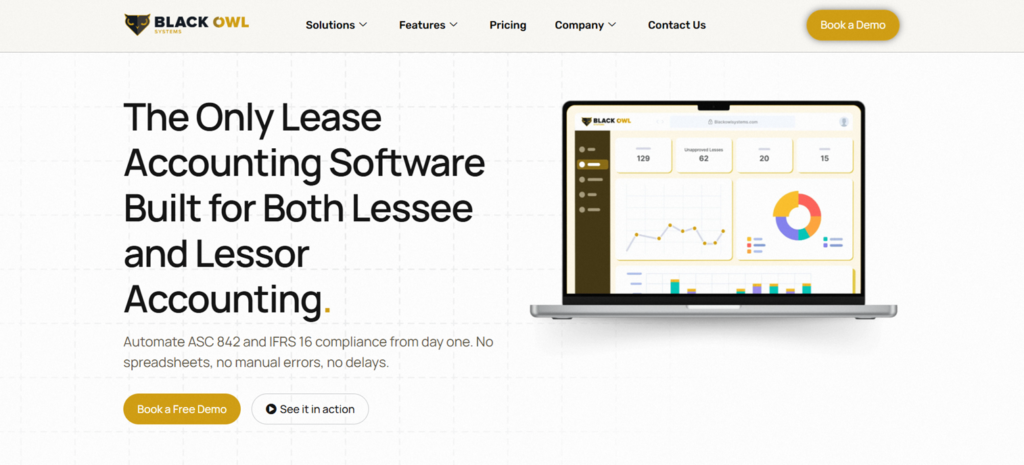
Modern lease accounting software like Black Owl Systems now plays a central role in modern financial management. As standards evolve and reporting demands grow, manual processes become harder to maintain.
By bringing data into one place, automating calculations, and simplifying reporting, these systems help finance teams work faster and with more confidence. At the same time, choosing the right platform requires a clear understanding of how it fits into daily work.
For teams exploring lease accounting software, looking beyond feature lists often makes the biggest difference. Seeing how a system handles real scenarios can reveal far more about whether it truly supports your processes.

Greg Kautz
Greg Kautz, CPA, CMA is a seasoned management consultant and professional accountant with over 40 years of experience in the consulting and energy sectors. At Black Owl Systems, Greg brings deep expertise in ERP systems, corporate finance, strategic planning, and technology integration.
