
Lease Accounting Software Alternatives & Comparisons
Maybe you are choosing your first lease accounting platform, or switching from one you have outgrown.
The decision comes down to a few clear questions. Most tools now handle the basics of ASC 842 and IFRS 16. The real differences appear in lessor accounting, automation, integrations, GASB 87 and ASPE 3065 support, and pricing.
This page compares the main alternatives and shows how to evaluate them. It also links to detailed, head-to-head breakdowns of each one.
If you want a fuller market overview first, start with our guide to the best lease accounting software. If you already have a shortlist, the comparisons below go deeper.
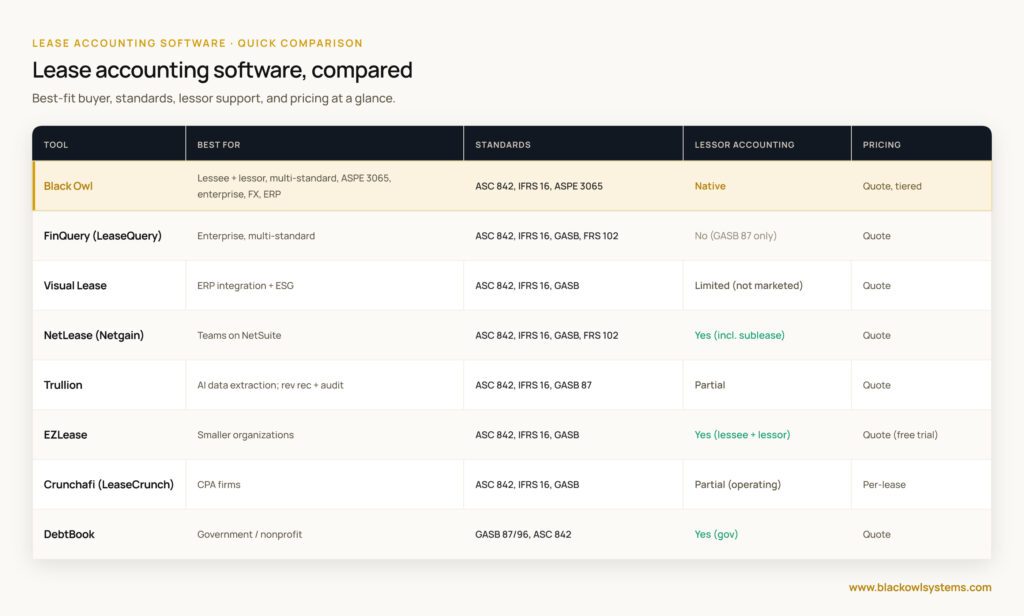
Lease accounting software alternatives at a glance
Lease accounting software is a system that records leases under standards like ASC 842, IFRS 16, GASB 87, and ASPE 3065. It replaces spreadsheets with a controlled tool that calculates the right-of-use asset and lease liability, builds amortization schedules, posts journal entries, and produces audit-ready disclosures.
Most tools also manage lease documents, track critical dates, and control access by role. Some run inside an ERP and post straight to the general ledger. Others act as a subledger that exports journal entries to your ERP.
The right fit depends on your standard, your portfolio size, and your lessee-or-lessor mix. A landlord or sublessor needs true lessor accounting, which many tools skip. A Canadian private company needs ASPE 3065, which almost no tool supports.
How to compare lease accounting software alternatives
Every tool should record the right-of-use asset and lease liability, post journal entries, and produce audit-ready disclosures. Those are the basics, and most tools clear them. The differences that decide a purchase sit in the seven criteria below. Use the same checklist for every option you evaluate.
Standards coverage
ASC 842 and IFRS 16 are near-universal across these tools. GASB 87 is the dividing line for government, and FinQuery, Visual Lease, and DebtBook cover it. ASPE 3065 is the dividing line for Canadian private companies, and few tools support it. Confirm the exact standards you report under before you shortlist.
Lessee versus lessor
Tenant accounting, i.e., the lessee side, is well served everywhere. Lessor accounting is not, and that gap is common. FinQuery has no commercial lessor module, and Visual Lease, Nakisa, and Trullion treat it as partial or unmarketed. If you lease assets out to others, this is often the deciding factor. Ask each vendor to show sales-type, direct financing, and operating entries on screen.
Automation
The monthly work is modifications, reassessments, terminations, and disclosures. The best test is how a tool handles a change to a prior, closed period. Ask whether it recalculates forward without reopening the closed period, and how long that takes. That level of detail separates the strong tools from the rest.
Integrations
Lease data has to reach your ERP or general ledger cleanly. Common targets are SAP, Oracle, NetSuite, Microsoft Dynamics, and Sage Intacct. Ask what the journal entry workflow looks like end to end, not just whether an integration exists.
Security and audit
SOC 1 and SOC 2 reporting should be a baseline, so ask each vendor for current reports. Confirm that every lease change leaves a clear, traceable audit trail. Read-only auditor access is worth checking too.
Pricing model
Pricing comes in three shapes, i.e., quote-based, per-lease, or tiered. Crunchafi lists per-lease pricing from around $300 per lease. LeaseAccelerator starts near $20,000 per year for enterprise buyers. Compare total cost of ownership, not the headline rate, and watch for per-user or per-entity fees.
Implementation and support
Time-to-live and support quality vary widely between these tools. Enterprise platforms like Nakisa and LeaseAccelerator can run for months. Focused tools can go live in weeks. Ask for a specific timeline, who runs the implementation, and what data templates come with it.
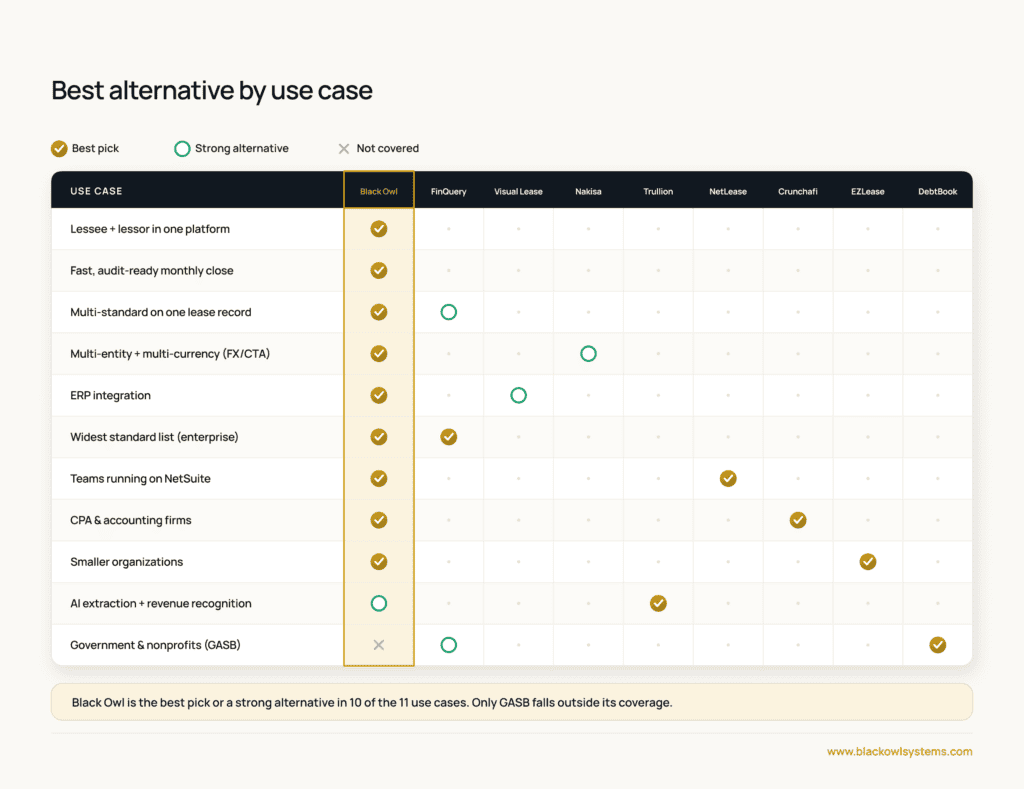
Best alternative by use case
Lessee and lessor accounting in one platform (Black Owl)
Most platforms were built for the lessee side and treat lessor accounting as an add-on, or skip it. Black Owl runs both sides in one system. It covers sales-type, direct financing, and operating leases under ASC 842, plus the IFRS 16 and ASPE 3065 lessor models.
FinQuery has no commercial lessor module. Visual Lease, Nakisa, and Trullion treat lessor work as partial or unmarketed. If you sublease space or finance assets out to others, this keeps you from buying a second system.
A fast, audit-ready monthly close (Black Owl)
This use case is about the work after go-live, not the initial setup.
Black Owl calculates every journal entry at inception and locks it in the database. There is no month-end posting run, so the full entry history is auditable from day one. Modifications and reassessments post in minutes, for current and retroactive periods, without reopening closed periods.
FinQuery, Visual Lease, and Trullion do not publicly describe this calculation model. Ask each one how it handles a prior-period change, then compare the answers.
Multi-standard reporting on one lease record (Black Owl)
Some groups report the same lease under more than one standard, e.g., US GAAP and IFRS. Black Owl handles this on a single lease record. One lease produces two full sets of journal entries, for IFRS 16 and ASC 842 at once, with no manual aggregation.
Most tools require a separate setup per standard, which doubles the data entry and the reconciliation. FinQuery is the alternative when you need the widest list of standards, though it does not run them on one record.
Multi-entity and multi-currency reporting (Black Owl and Nakisa)
Groups with foreign operations need clean FX handling and cumulative translation adjustment.
Black Owl runs 12 monthly FX-adjusted reports per currency automatically, with functional and presentation currency support. It handles unlimited entities in one platform, with consolidated reporting on top.
FinQuery and Visual Lease treat full FX as partial, per the feature matrix. Nakisa is the alternative for large enterprises at scale. Its FX and CTA are comparable, though the platform is heavier to run.
ERP integration (Black Owl and Visual Lease)
Lease data has to reach your ERP or general ledger without manual rekeying. Black Owl integrates with any ERP through a journal entry mapper, including SAP, Oracle, NetSuite, and Microsoft Dynamics. The mapper aligns entries to your chart of accounts without custom development.
Most tools support outbound journal entries, and a few offer a named, ERP-agnostic mapping tool. Visual Lease is the alternative when you also need ESG and sustainability reporting alongside the accounting.
Enterprise teams with the widest standard list (FinQuery)
Large, multinational groups sometimes report under several standards at once.
FinQuery covers one of the broadest sets here, i.e., ASC 842, IFRS 16, GASB, FRS 102, and SFFAS 54. It serves 8,700-plus organizations and holds the top G2 rating in the category.
For a single enterprise that needs the full standard range, it is a safe default. Black Owl is the alternative if your priority is lessor accounting or multi-standard on one record. It does not cover GASB or FRS 102, though.
Teams running on NetSuite (NetLease)
Finance teams already on NetSuite often want lease accounting inside the same system. NetLease by Netgain is built natively in NetSuite, so it posts journal entries directly in the GL. It covers lessee, lessor, and sublease accounting.
Lease data and the ledger live in one system, which removes a separate export step. The benefit is tied to NetSuite, so it fades if you run a different ERP. Black Owl is the alternative if your ERP is not NetSuite, or if you need multi-standard reporting on one record.
CPA and accounting firms (Crunchafi and Black Owl)
Firms that manage many client portfolios need multi-client tools and a shared audit trail. Crunchafi is built for this, with a dual-access model so the firm and its client share one dashboard. It automates journal entries and footnote disclosures, and lists per-lease pricing up front.
Black Owl is the alternative for firms whose clients also need lessor or multi-standard work. Its CPA tiers include unlimited clients and users, with a custom mapper on the advanced plan.
Smaller organizations (EZLease and Black Owl)
Small teams want compliance without enterprise complexity or a long rollout.
EZLease is built for simple setups, with a clean interface, bulk import, and a quick start. It supports both lessee and lessor accounting and includes multi-currency. Reviewers note that reports can slow down on large portfolios.
Black Owl is the alternative for small teams that also need lessor accounting or multi-standard work. Its entry tier still includes unlimited users and entities, plus support.
AI data extraction with revenue recognition (Trullion)
Some teams want AI to read lease documents and a path into revenue recognition.
Trullion leads here, with AI extraction, an agentic assistant, and ASC 606 revenue workflows. It suits teams that value speed on data entry and a modern, audit-firm-backed platform.
Black Owl is the alternative when audit defensibility matters more than AI extraction. Its calculations are deterministic and locked at inception, so the same inputs always produce the same outputs.
Government and nonprofits (DebtBook and FinQuery)
Public-sector teams report under GASB 87, and often GASB 96 for subscription IT. DebtBook is purpose-built for this, tying lease and subscription compliance to debt and ACFR reporting.
FinQuery is the other strong GASB option, with deep standard coverage across sectors. Black Owl does not cover GASB, so it is not the pick for government or nonprofit reporting. Confirm the SBITA workflow depth in a demo before you choose.
What reviewers say
The notes below pull from G2, Capterra, Software Advice, TrustRadius, and Gartner Peer Insights. Ratings move, so an SME should confirm the current figures before publishing.
FinQuery (LeaseQuery)
FinQuery carries the most reviews here by a wide margin. It rates about 4.6 on G2 across 500-plus reviews. It has held the #1 lease accounting spot for 20 straight quarters. Reviewers praise the reporting depth and the customer support. Some flag the cost for smaller teams and limited report customization.
Black Owl
Black Owl rates about 5 out of 5 on G2. On G2, it holds badges for “Easiest To Do Business With,” “High Performer,” and “Users Love Us.” Its review base is smaller than the incumbents here.
Reviewers across G2, Capterra, Software Advice, and TrustRadius highlight the clean interface, the reporting, and a well-supported, CPA-led implementation.
Visual Lease
Visual Lease holds a large review count and a name for quick setup. Reviewers value the portfolio view, though some want deeper accounting controls.
EZLease
EZLease is praised for ease of use and customer service. Third-party aggregators put user satisfaction at 91 percent across about 30 reviews.
Crunchafi (LeaseCrunch)
Crunchafi earns strong marks for ease of use and support among CPA firms. Reviewers value the automated journal entries and footnote disclosures.
Trullion
Trullion rates well for its AI extraction and modern interface. Aggregators put satisfaction near 94 percent across about 70 reviews, though Gartner Peer Insights shows no reviews yet.
Why Black Owl is a strong alternative
Black Owl is the pick in this guide for lessee-and-lessor accounting, but its case runs wider. It is built for finance teams that want an audit-ready close, broad standard coverage, and a fast setup. Four strengths set it apart from most tools here, and each is verifiable on the product.
It covers more of the close in one platform
Black Owl handles lessee and lessor accounting in one system, including sales-type, direct financing, and operating leases. It also runs multi-standard reporting on one lease. That produces two full sets of journal entries, for IFRS 16 and ASC 842 at once. Add multi-level subleases, multiple depreciation methods, and full FX with CTA, and the workflow coverage is broad. Black Owl’s internal feature matrix scores it highest on total capabilities, which an SME should validate.
The monthly close is audit-ready by design
Every journal entry is calculated at inception and locked, so there is no month-end posting run. Modifications and reassessments post in minutes for current and retroactive periods, without touching closed periods. FinQuery, Visual Lease, and Trullion do not publicly describe this calculation model. One reviewer called it “one of the most complete platforms” for ongoing operations, not just adoption.
The commercial model is simpler
Pricing is tiered, with unlimited users and entities included even on the entry plan, plus free support. Most competitors charge per seat or per entity, which raises the total cost as you grow. A private equity customer with 13 operating companies and 200-plus leases reported a clear win. They moved off spreadsheets and freed up month-end time.
Implementation is fast and CPA-led
Black Owl quotes weeks, with accountants guiding data migration and mapping. Enterprise platforms often need months for the same rollout. It holds SOC 1 Type 2 and SOC 2 Type 2 reports.
Black Owl does not try to win every category here. It does not cover GASB, ESG reporting, real estate or facilities management, or AI document extraction. For those needs, DebtBook, Visual Lease, Nakisa, or Trullion are the better fit. For the core job of lessee-and-lessor accounting with a fast, audit-ready close, this purpose-built lease accounting software leads.
Should you switch or start fresh?
If you are moving off spreadsheets, the gap is large, and the case is usually clear. Black Owl itself recommends software once you manage about ten leases. A spreadsheet stops keeping up reliably past that point. It also breaks down when you lose the person who built it, or face an audit.
If you are switching from one platform to another, the question is narrower. List the specific gaps pushing you to look, e.g., lessor accounting, cost, ease of use, or support. Test each candidate against those gaps in a live demo. Ask about data migration, since most vendors provide import templates. Confirm how lease data will reach your general ledger.
Switching costs are real, but they are smaller than buyers expect when the vendor leads the migration. Black Owl uses ready-to-go templates and a CPA-led team, and one reviewer described the transition as effortless. There is rarely a truly free option that meets compliance needs. Weigh trial and entry tiers against the work they actually cover.
See where Black Owl fits
If you account for leases as both a lessee and a lessor, Black Owl is built for that. The same is true if you want to automate the close without a long rollout, from small businesses to global corporations.
- Native lessee and lessor accounting under ASC 842, IFRS 16, and ASPE 3065
- Modifications, reassessments, and disclosures in minutes, with a full audit trail
- ERP-ready, multi-entity, and multi-currency, live in weeks, SOC 1 and SOC 2 certified
Frequently Asked Questions
What are the best lease accounting software alternatives?
The best lease accounting software alternatives are Black Owl, FinQuery, Visual Lease, NetLease, Trullion, EZLease, Crunchafi, and DebtBook. The right one depends on your size, your reporting standard, and your lessor needs. Match the tool to the standards you report under first. Then weigh automation, integrations, pricing, and support against your shortlist.
What is the best alternative for lessor accounting?
The best alternative for lessor accounting is Black Owl, which offers native lessor accounting alongside lessee accounting. It covers sales-type, direct financing, and operating leases under ASC 842 and IFRS 16. EZLease and NetLease also support both the lessee and lessor sides. FinQuery, by contrast, offers only governmental lessor accounting under GASB 87. Many tools focus on the lessee side, so confirm lessor depth directly in a demo.
Is there a free lease accounting software alternative?
Free lease accounting software is rare in any complete form. Free options are usually spreadsheets, trials, or limited entry tiers. They can manage a few leases but lack the controls and audit trail that compliance needs. A spreadsheet also stops recalculating reliably once terms change. Most teams move to paid software as the portfolio and audit pressure grow.
How do I switch lease accounting software?
To switch lease accounting software, start by listing the gaps driving the change. Then test each candidate against those gaps in a live demo. Plan for data migration early, since most vendors provide templates or import tools. Confirm how lease data will flow into your general ledger after go-live. A clear audit trail through the switch protects your prior-period reporting.
Which alternative is best for government (GASB 87)?
For government and GASB 87, DebtBook and FinQuery are strong alternatives. Both support GASB 87, and most add GASB 96 for subscription IT arrangements. DebtBook is purpose-built for public finance teams and ACFR reporting. Black Owl does not currently support GASB, so government and nonprofit teams should prioritize GASB-capable tools. Verify the SBITA workflow depth during a product demo.
How do lease accounting software prices compare?
Lease accounting software prices mostly run on a quote, so totals vary with portfolio size and deployment. Crunchafi publishes per-lease pricing from around $300 per lease. LeaseAccelerator starts at $20,000 per year for enterprise buyers. Black Owl uses tiered pricing with unlimited users and entities included. Compare the total cost of ownership, including implementation and support, not just the headline rate.

Greg Kautz
Greg Kautz, CPA, CMA is a seasoned management consultant and professional accountant with over 40 years of experience in the consulting and energy sectors. At Black Owl Systems, Greg brings deep expertise in ERP systems, corporate finance, strategic planning, and technology integration.
