
How to Identify Embedded Leases Under ASC 842, With Examples and Journal Entries
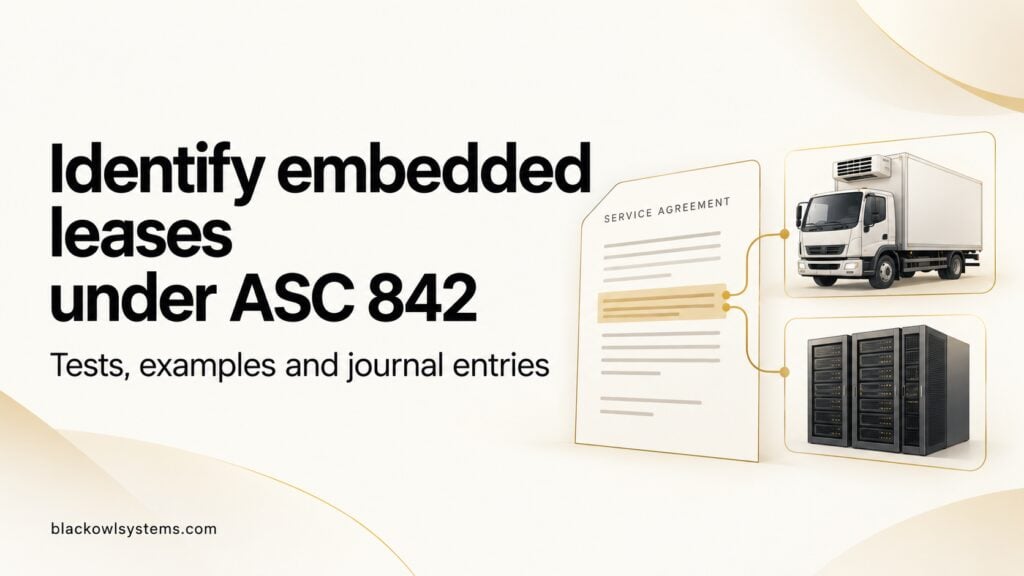
An embedded lease gives a customer the right to use an identified asset through a contract for goods or services. The agreement may never be described as a lease or even mention one. That does not remove the accounting obligation: under ASC 842, an embedded lease still creates a right-of-use asset and a lease liability. Identifying these arrangements is necessary to establish a complete lease population.
Black Owl’s lease accounting platform keeps identified leases and their accounting records together as the portfolio changes.
Which arrangements are not embedded leases?
Three recurring questions tend to complicate embedded lease reviews before the work begins. Resolving them saves time and prevents one particularly common mix-up from sending the accounting team to the wrong standard.
Can you give me an example of an embedded derivative?
An embedded derivative is a provision within a host contract that functions like a derivative on its own. One common example is a purchase agreement priced in a foreign currency unrelated to either contracting party. ASC 815 governs these provisions; lease accounting does not.
The shared word “embedded” is the only connection. An embedded lease provides a right to use a physical asset under ASC 842. An embedded derivative creates exposure to a financial variable under ASC 815.
What are the four types of leases?
This question generally mixes up accounting classifications with commercial real estate terminology. ASC 842 gives lessees two classifications: finance and operating. Lessors have three: sales-type, direct financing, and operating.
The four-category list belongs to commercial real estate. Gross, net, modified gross, and percentage leases describe arrangements for paying operating costs. Neither set of labels determines whether a goods or services contract contains an embedded lease.
Teams reporting under IFRS 16 or ASPE 3065 should assess the contract under the applicable framework, as discussed below.
What is the 90% rule in leasing?
The 90% threshold comes from ASC 840, the standard that ASC 842 replaced. Under ASC 840, a lease qualified as a capital lease when the present value of its minimum payments reached 90% of the asset’s fair value.
ASC 842 removed that fixed threshold. The question is now whether the payments represent substantially all of the underlying asset’s fair value.
Companies can still adopt 90% as a documented internal policy threshold, and many do. It is permitted, not mandatory. The change from bright-line thresholds to classification tests applies to embedded leases just as it does to other leases. All are classified using the same five tests.
The more important distinction is between a lease and a service arrangement. That decision turns on the existence of an identified asset and who controls its use.
The agreement’s title and invoicing format do not decide the answer. Nor does the fact that the supplier operates the asset for the customer.
A centralized lease management record helps retain contracts and review conclusions. Black Owl’s implementation and advisory services can support the accounting workflow.
What is an example of an embedded lease?
Embedded leases tend to occur in a relatively small group of contract types. Focusing on those agreements can substantially narrow the search. The examples below are ordered by how frequently they arise in practice.
| Contract type | Asset involved | Basis for lease treatment | How often it is overlooked |
|---|---|---|---|
| IT hosting and data center agreements | Dedicated servers, racks, or cages | The customer controls specified hardware throughout the contract term | Very often |
| Transportation and dedicated delivery | Named trucks, trailers, or rail cars | The fleet serves the customer exclusively, and the customer determines routing | Very often |
| Contract manufacturing | A dedicated production line or machine | The line produces only the customer’s goods during the term | Often |
| Warehousing and rack space | A defined area, bay, or group of racks | The agreement specifies space that is not interchangeable | Often |
| Advertising and billboards | A particular billboard or display panel | The contract names a location that cannot be freely substituted | Often |
| Cable and telecom service | Set-top boxes, routers, and customer premises equipment | The equipment remains at the customer’s premises for the term | Sometimes |
| Managed service and device bundles | Printers, copiers, and diagnostic equipment | Devices are installed on site under a per-use pricing arrangement | Sometimes |
| Supply agreements and pipelines | A dedicated pipeline segment or storage tank | The capacity is reserved exclusively rather than shared | Sometimes |
| Drilling and oilfield services | A named rig or vessel | The supplier commits the rig to the customer for a defined period | Sometimes |
| Power purchase agreements | A specific generating facility | The customer receives substantially all output from a named plant | Sometimes |
| Medical and laboratory equipment | Analyzers provided through reagent contracts | Equipment is supplied without a separate charge in return for committed consumable volumes | Sometimes |
| Vending, ATMs, and beverage equipment | The installed machine | The machine is located on the customer’s premises | Rarely reviewed |
Two features recur across these arrangements. One is dedication: the asset serves a single customer instead of a wider pool. The other is placement: physical equipment is installed at the customer’s site.
Either feature should prompt a review of the agreement. When both are present, the arrangement almost always contains an embedded lease.
Because these rights sit within other familiar forms of commercial contracts, a search filtered by contract type can overlook them.
First test: does the contract identify an asset?
The identified asset test has two parts. The arrangement must specify a particular asset, and the supplier must not have a substantive right to replace it.
ASC 842-10-15-9 through 15-15 set out these requirements. Reviews often address the first part without working through the second.
Assets can be identified explicitly or implicitly
Explicit identification is usually straightforward to spot. A serial number, location, or description names the asset in the agreement.
Implicit identification occurs more frequently and is easier to overlook. It arises when the supplier needs one particular asset to fulfill the contract, even though the document never names it.
For example, a supplier with only one facility in the region has implicitly identified that facility. Leaving its name out of the agreement does not change the conclusion.
Consider what the supplier would actually use to perform its obligations. Where the answer is one specific asset, identification exists regardless of the contract’s wording.
A substitution clause must be substantive to rule out a lease
A contractual right to replace an asset does not automatically prevent lease treatment. Under ASC 842, that right must meet two conditions to be substantive. The supplier must be able to substitute other assets throughout the period of use, and doing so must provide an economic benefit to the supplier.
A provision permitting substitution at the supplier’s own cost, with no corresponding benefit, does not satisfy the second condition.
This is where many embedded lease reviews break down. The reviewer finds substitution language and stops, assuming there is no identified asset. Such boilerplate appears in most service agreements but rarely satisfies the substantive test.
A no-lease conclusion needs supporting facts in the file. The supplier may fulfil the contract using a pool of interchangeable assets, move work between facilities for its own operational reasons, or agree to deliver an output without committing an asset. Each of these facts can support that conclusion and should be documented.
Where several assets fall within one agreement, assess identification separately for each. A contract covering multiple assets can contain one lease, several leases, or no lease at all.
Second test: does the customer control the asset?
ASC 842-10-15-4 requires both elements of control to be present. The customer must receive substantially all economic benefits from using the asset and have the right to determine how and for what purpose it is used.
Receiving substantially all economic benefits
The assessment covers the asset’s main output, its by-products, and any secondary uses. Look at benefits during the period of use, not across the asset’s entire life.
A customer receiving all production from a dedicated line obtains substantially all of its economic benefits. A customer receiving 40% of the output from a shared line does not. Payments to the supplier are the consideration for the arrangement; they are not economic benefits the customer has surrendered.
Directing the asset’s use
The right to direct use concerns decisions about how and for what purpose the asset operates during the period of use. Those decisions include what it produces, when production occurs, and where it is deployed.
When the agreement has already predetermined those decisions, ASC 842 provides another route. A customer that designed the asset to predetermine its use can satisfy this requirement. A customer that operates the asset itself can also meet this part of the test.
By contrast, a supplier using its own equipment to deliver a specified result usually retains the right to direct that equipment.
The supplier must consider the same identification and control tests from its side of the agreement. The lessor’s assessment under ASC 842 follows the same principles. Suppliers overlook their lessor obligations for the same reasons customers miss embedded leases.
A decision tree for embedded leases
Apply the tests in sequence, stopping as soon as a condition rules out lease treatment.
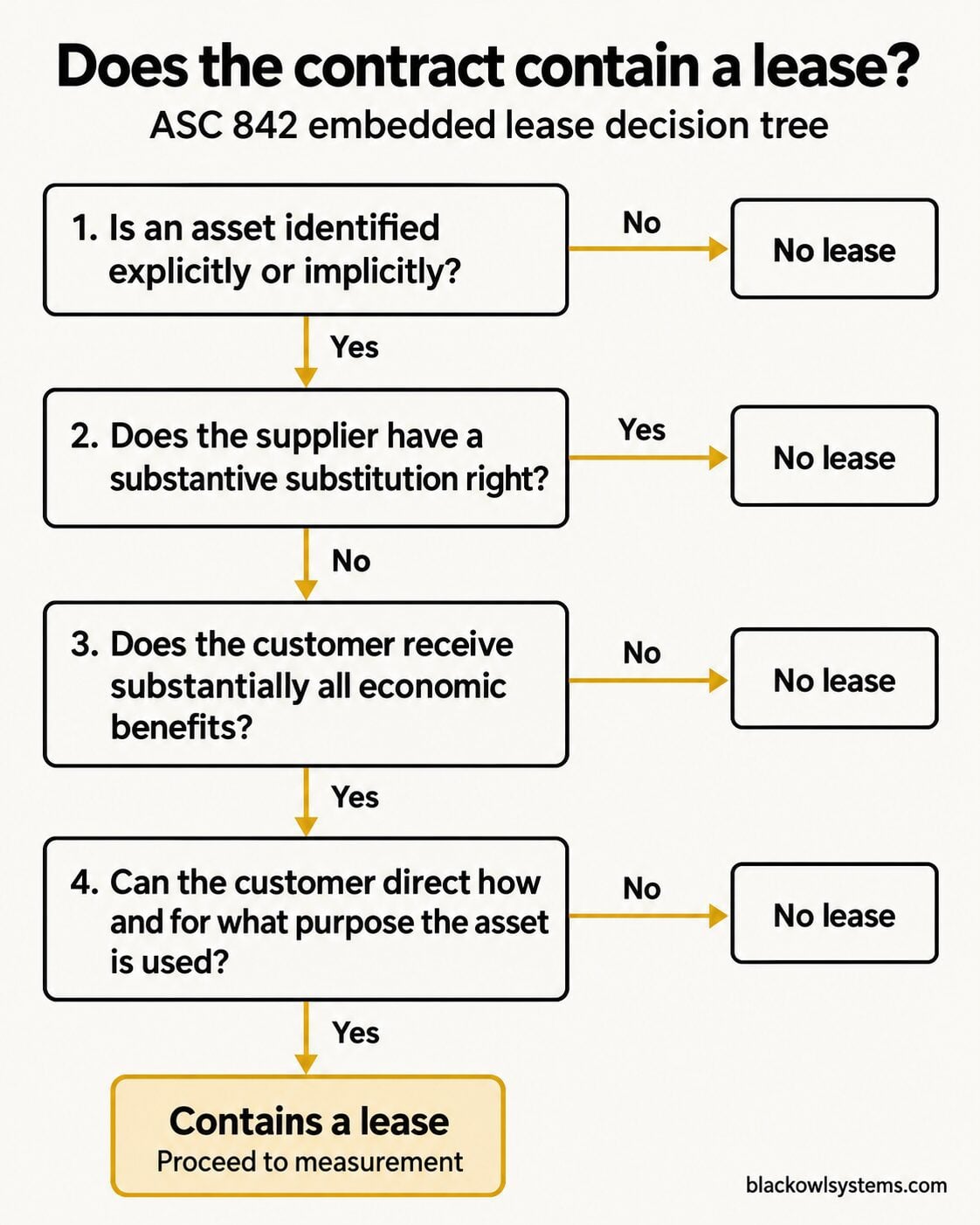
- Does the agreement specify an asset, either explicitly or implicitly? A “no” means there is no lease.
- Does the supplier have a substantive substitution right? A “yes” means there is no lease.
- Does the customer receive substantially all economic benefits during the period of use? A “no” means there is no lease.
- Can the customer direct how and for what purpose the asset is used? A “no” means there is no lease.
- When all four answers support lease treatment, the contract contains a lease. Proceed to measurement.
Searching a contract portfolio for embedded leases
A common approach is to search the contract repository, find few candidates, and conclude that no embedded leases exist. That is an unreliable starting point because the agreements being sought were not filed as leases in the first place.
Begin with accounts payable
Consistent payments to the same supplier are the strongest single indicator available. Extract twelve months of accounts payable data and group it by vendor, looking for similar monthly amounts. Read the agreements behind those recurring payments.
Then use the contract categories above to prioritize the results. A logistics supplier billing a steady monthly amount deserves attention before a consulting firm with the same payment pattern.
| Source | What it reveals | Effort required | Main limitation |
|---|---|---|---|
| Accounts payable spend analysis | Repeated vendor payments that may indicate committed capacity | Low; one query | Variable, per-use billing can escape detection |
| Vendor master file | The full supplier population, organized by category | Low | Provides no information about the contract terms |
| Contract repository | Agreements that have been filed centrally | Medium | Excludes business-unit contracts that were never submitted |
| Business unit interviews | On-site equipment, dedicated capacity, and informal arrangements | High | Results depend on what the participants remember |
| Procurement pipeline | Arrangements being considered before signature | Medium; ongoing | Does not identify the existing contract population |
Start with the accounts payable analysis and vendor master file. Both require very little effort and establish the scope for the more time-consuming work that follows.
Establishing a defensible materiality threshold
There is no requirement to read every contract, and auditors do not expect an exhaustive review. They expect a deliberately chosen threshold that has been applied consistently.
Base the threshold on annual spend and record the reasoning behind it. Review all contracts above that amount and sample those below it. Make the judgment about what is small enough to exclude before the review begins, and document it.
For agreements that pass both the identification and control tests, collect the usual lease data. The information needed to build the accounting record is the same whether the lease is embedded or expressly described as a lease.
Worked example: separating a logistics agreement into components
This example is illustrative, including the assumed $1,600,000 fleet fair value.
A food distributor enters a three-year dedicated logistics agreement with a carrier. The carrier commits ten named refrigerated trucks to the arrangement. The distributor pays annual consideration of $1,200,000 at the end of each year.
The arrangement passes both tests. Naming the trucks and restricting the carrier’s ability to substitute them establishes the identified assets. The distributor receives all delivery capacity and determines the routes and schedules, giving it control.
There are two components to account for: the trucks constitute the lease component, while the driving service is the non-lease component. ASC 842 requires consideration to be allocated using their relative standalone prices.
| Component | Standalone price | Allocation % | Allocated consideration |
|---|---|---|---|
| Lease of ten refrigerated trucks | $450,000 | 33.33% | $400,000 |
| Delivery and driver service | $900,000 | 66.67% | $800,000 |
| Total | $1,350,000 | 100.00% | $1,200,000 |
The allocation produces lease payments of $400,000 a year over the three-year term. Because the carrier does not disclose the implicit rate, the distributor uses its incremental borrowing rate of 6%.
That rate requires its own support. Estimating the discount rate when the implicit rate is unavailable is a separate accounting exercise, supported by evidence from the accounting team.
Discounting three annual payments of $400,000 at 6% gives a present value of $1,069,205.
The next step is classification under the five standard tests. The three-year lease term represents 38% of the trucks’ eight-year economic life. The present value of $1,069,205 represents 66.8% of the fleet’s $1,600,000 fair value.
The agreement contains neither an ownership transfer nor a purchase option, and the refrigerated trucks are not specialized assets. On these facts, the embedded lease is an operating lease.
At commencement, the distributor records the following entry:
| Account | Debit | Credit |
|---|---|---|
| Right-of-use asset | $1,069,205 | |
| Lease liability | $1,069,205 |
In each subsequent year, the accounting includes interest on the lease liability and amortization of the right-of-use asset. The annual $800,000 service component is excluded from both balances and expensed as incurred.
| Year | Interest at 6% | ROU amortization | ROU carrying amount | Lease liability |
|---|---|---|---|---|
| Commencement | $1,069,205 | $1,069,205 | ||
| 1 | $64,152 | $335,848 | $733,357 | $733,357 |
| 2 | $44,001 | $355,999 | $377,358 | $377,358 |
| 3 | $22,642 | $377,358 | $0 | $0 |
Total annual lease cost is $400,000, reflecting the allocated consideration spread evenly over the term. From this point, the lessee’s journal entries follow the usual operating lease pattern.
A class-level policy election can materially change this schedule. ASC 842 allows lessees to elect not to separate lease and non-lease components for a class of assets. With that election, the entire $1,200,000 annual payment is treated as a lease payment, producing a lease liability of $3,207,614.
The balance sheet carries an additional $2,138,410 as a result of that single decision. Avoiding the allocation exercise saves work but uses more balance sheet capacity. Make the election deliberately for the asset class, not separately for each contract.
Do SaaS and cloud agreements contain embedded leases?
Most software-as-a-service agreements do not contain a lease because they do not identify an asset. The customer buys access to software hosted on shared infrastructure. Those hosting arrangements fall under ASC 350-40 rather than ASC 842.
Specified hardware changes the assessment. A dedicated server, named rack, or private cage identifies an asset. When the customer also controls how that hardware is used, the arrangement falls under ASC 842 instead.
One practical question is whether the provider could move the workload without notifying the customer. Where it can, the agreement is a hosting arrangement under ASC 350-40. Where it cannot, review the contract for an embedded lease.
The consequences of overlooking an embedded lease
Failing to identify an embedded lease understates both the right-of-use asset and the lease liability. Across a portfolio, those omissions accumulate. The problem first becomes apparent in the disclosures, where maturity analyses do not reconcile to the underlying contracts.
Completeness is a specific audit assertion for the lease population. Auditors will ask which search procedures were used, how the threshold was determined, and what the review found. A documented search that found no embedded leases is an acceptable result. An absence of documented search work is not.
When a missed lease is identified later, the correction requires recognition as though it had been recorded at commencement. Material amounts lead to prior-period adjustments. Assemble the evidence needed to demonstrate lease completeness during the search, while the work is being done.
How IFRS 16, GASB 87, and ASPE 3065 treat embedded leases
Identification tests are closely aligned across the major standards. Differences in allocation requirements and available practical expedients affect how much work each contract involves.
| Standard | Identification test | Allocation requirement | Available practical expedient |
|---|---|---|---|
| ASC 842 | An identified asset and the right to control its use | Allocate using relative standalone prices | Yes; a non-separation election is available by asset class |
| IFRS 16 | An identified asset and the right to control its use, with nearly identical wording | Allocate using relative stand-alone prices | Yes; a non-separation election is available by asset class |
| GASB 87 | The right to use an underlying asset in an exchange transaction | Separate components where practicable | Limited; there is no broad election not to separate components |
| ASPE 3065 | A risks-and-rewards assessment, closer to the former ASC 840 model | Allocation follows the classification tests | Not applicable; the standard uses a different model |
ASPE 3065 did not adopt the control model, an important distinction for Canadian private companies. An agreement containing an embedded lease under ASC 842 may not contain one under ASPE 3065. The Canadian private enterprise standard assesses the same contract through a different framework.

Greg Kautz
Greg Kautz, CPA, CMA is a seasoned management consultant and professional accountant with over 40 years of experience in the consulting and energy sectors. At Black Owl Systems, Greg brings deep expertise in ERP systems, corporate finance, strategic planning, and technology integration.
