
Best Lease Accounting Software in 2026 (Compared)
Lease accounting once ran on spreadsheets and manual month-end reconciliations. ASC 842, IFRS 16, GASB 87, and ASPE 3065 set stricter rules for measurement, disclosure, and audit support. Most finance teams now use purpose-built lease accounting software instead of error-prone spreadsheets.
The hard part is choosing the right one for your situation. Dozens of tools claim to do lease accounting, and they are not the same. Some are full accounting engines, and some are lease administration tools with accounting added on. Others are close or reporting platforms that rely on a separate lease subledger.
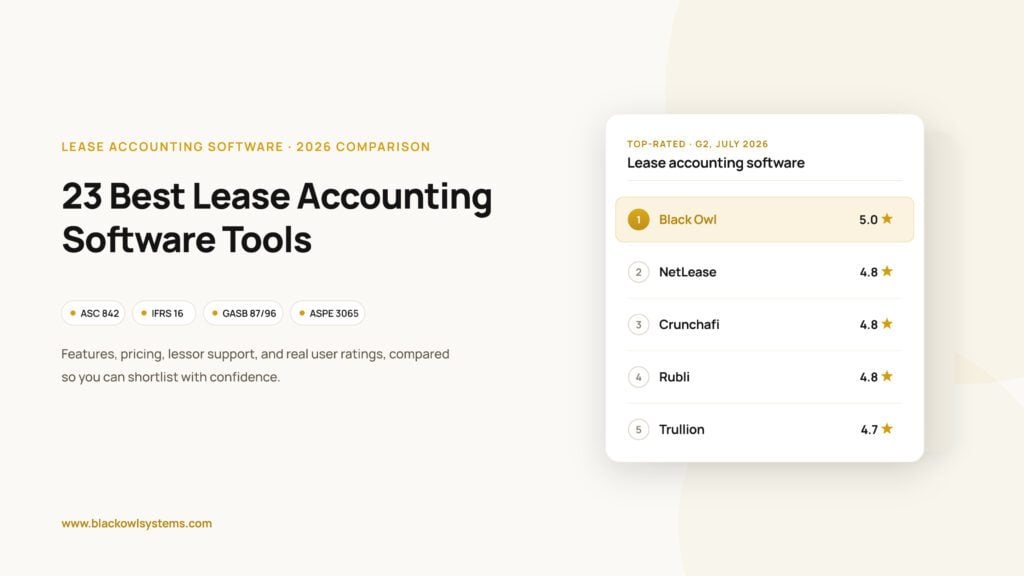
This guide compares 23 of the best lease accounting software tools for 2026. For each one, we cover the best-fit buyer, standards, key features, and pricing.
What is lease accounting software?
Lease accounting software is a system that records leases under standards like ASC 842, IFRS 16, GASB 87, and ASPE 3065. It replaces spreadsheets with a controlled tool that calculates the right-of-use asset and lease liability, builds amortization schedules, posts journal entries, and produces audit-ready disclosures.
Most tools also manage lease documents, track critical dates, and control access by role. Some run inside an ERP and post straight to the general ledger. Others act as a subledger that exports journal entries to your ERP.
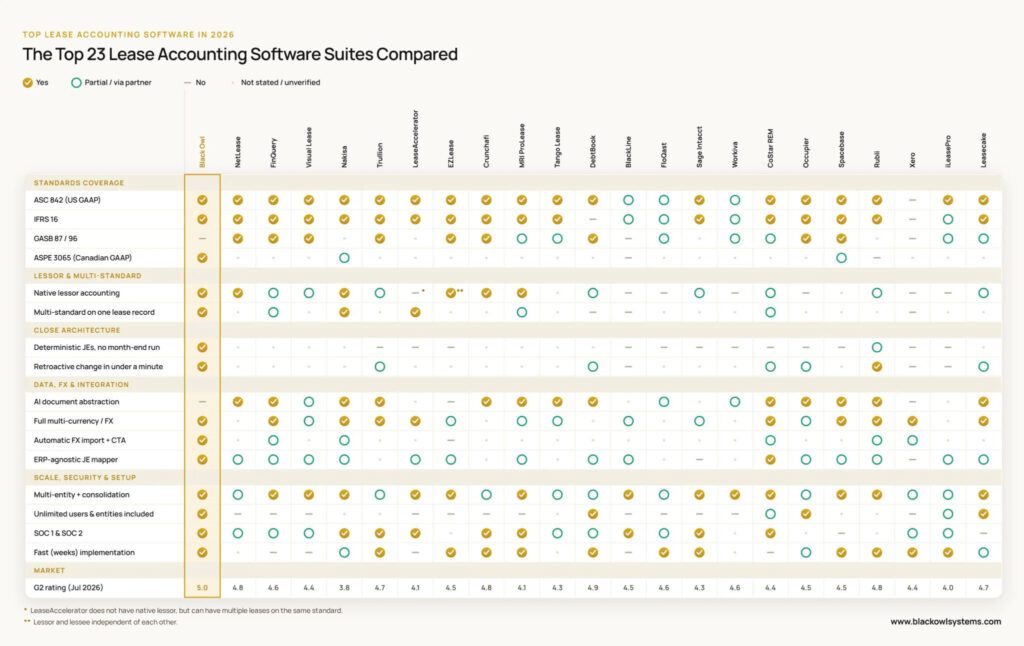
The right fit depends on your standard, your portfolio size, and your lessee-or-lessor mix. A landlord or sublessor needs true lessor accounting, which many tools skip. A Canadian private company needs ASPE 3065, which almost no tool supports.
Benefits of lease accounting software
Lease accounting software helps finance teams stay compliant, close faster, and reduce manual errors. The main benefits are below.
Centralizes lease data
The software holds every lease and its financial terms in one place. Teams stop tracking separate versions across spreadsheets and shared drives. Everyone works from the same record, which cuts duplicate work and reconciliation disputes.
Maintains compliance
ASC 842, IFRS 16, GASB 87, and ASPE 3065 require detailed tracking that spreadsheets struggle to hold at scale. The software automates classification, right-of-use asset and lease liability calculations, and journal entries. It also keeps audit-ready documentation and a clear view of lease obligations.
Improves accuracy
Manual entry is slow and error-prone. Automated calculations and built-in validations cut the risk of a wrong number reaching the financial statements. Cleaner data means fewer audit surprises and fewer restatements.
Automates routine work
Payment schedules, monthly journal entries, remeasurements, and disclosures are repetitive tasks. The software runs them for you. That frees the accounting team for review and analysis, and it supports a faster month-end close.
Improves financial reporting
The software produces standard disclosure and management reports that match each standard. Dashboards show lease liabilities, upcoming dates, and portfolio changes in one view. Better data means faster, more informed decisions.
How we evaluated these tools
We are accountants, and we built Black Owl for accountants. So we assessed each tool the way a controller would during a real evaluation. ASC 842 support is the baseline, and beyond that, we looked at the following six areas:
- Standards coverage. ASC 842, IFRS 16, GASB 87 and 96, ASPE 3065, and FRS 102. GASB depth and ASPE support vary the most between tools.
- Lessee versus lessor support. Many tools do tenant accounting well but treat lessor accounting as partial or skip it. We call this out for every tool.
- Automation. How the tool handles modifications, reassessments, journal entries, and disclosures without manual work.
- Integrations. How lease data flows into your ERP or general ledger, e.g., SAP, Oracle, NetSuite, or Dynamics.
- Scale and support. Multi-entity and multi-currency handling, plus how long the implementation takes.
- Pricing and ratings. The pricing model, plus verified reviews on G2 and Capterra.
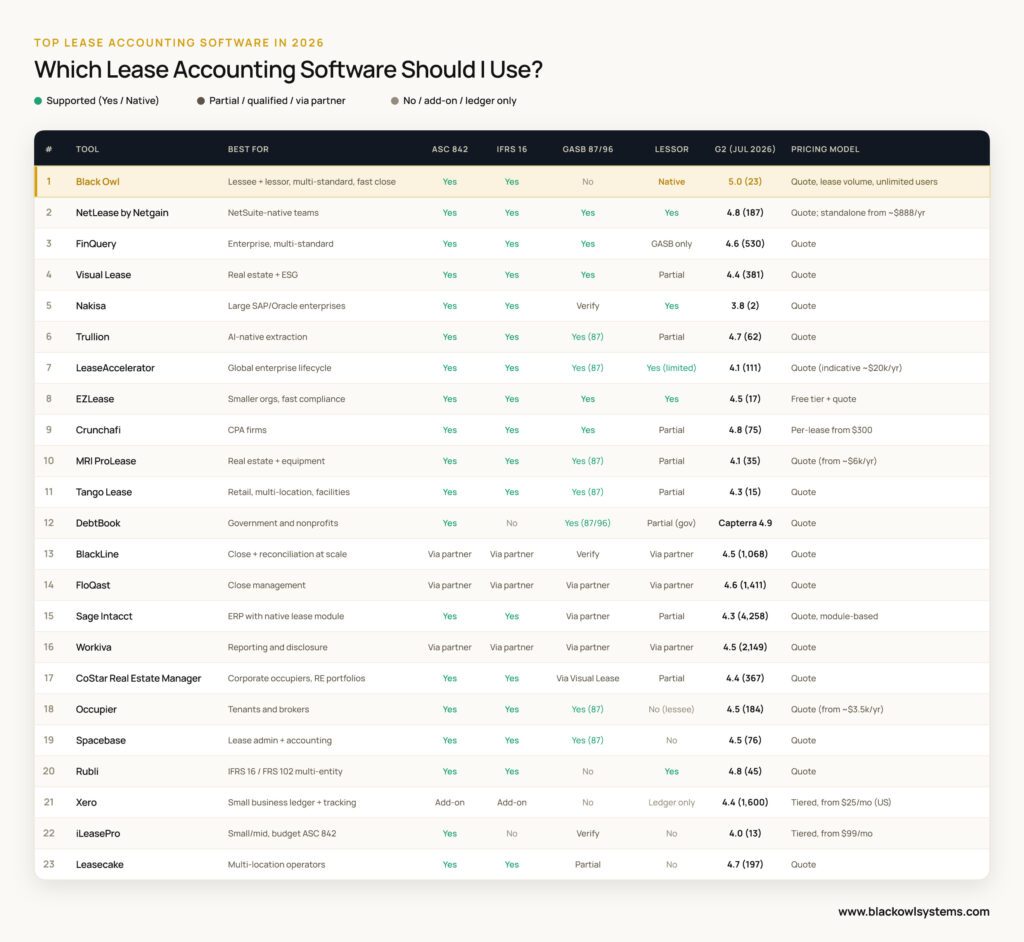
Lease accounting software comparison table
The 23 best lease accounting software tools
Below is each tool in detail, starting with Black Owl. For every tool we list the best-fit buyer, standards, ratings, key features, verified pros and cons, and pricing. Add a product screenshot to each entry before publishing.
1. Black Owl
Best for: Companies that are both lessee and lessor, report under more than one standard, or need a fast, audit-ready close.
Black Owl is lease accounting software built by accountants for finance teams that own the close. Its clearest difference is native lessor accounting in the same platform as lessee accounting. It is also the only tool in this guide that supports ASC 842 (US GAAP), IFRS 16, and ASPE 3065 for Canadian private companies together.
Standards: ASC 842, IFRS 16, ASPE 3065. Native lessor accounting. Does not cover GASB.
Ratings: G2 5.0/5 (23 reviews) · Capterra 4.8/5 (4 reviews), as of July 2026.
Key features:
- Native lessee and lessor accounting, i.e., operating, finance, sales-type, and direct financing leases
- Multi-standard on one lease record, producing ASC 842, IFRS 16, and ASPE 3065 schedules at once
- Journal entries are calculated at inception and locked, so there is no month-end posting run
- Retroactive and current modifications in under a minute, with a version-controlled audit trail
- Daily FX import and cumulative translation adjustments; unlimited users and entities; SOC 1 and SOC 2 Type 2
Pros:
- Reviewers say it removes spreadsheet workarounds and produces clean, audit-ready schedules for complex, changing leases (G2).
- Customers highlight accountant-led implementation and support, with most teams going live in weeks (Capterra).
Cons:
- Some reviewers note that reporting and customization are still improving, with occasional reporting bugs (G2).
- A few users report a learning curve on the first lease upload (G2).
Pricing: Quote-based on lease volume, with unlimited users and entities included. See plans and pricing or book a walkthrough.
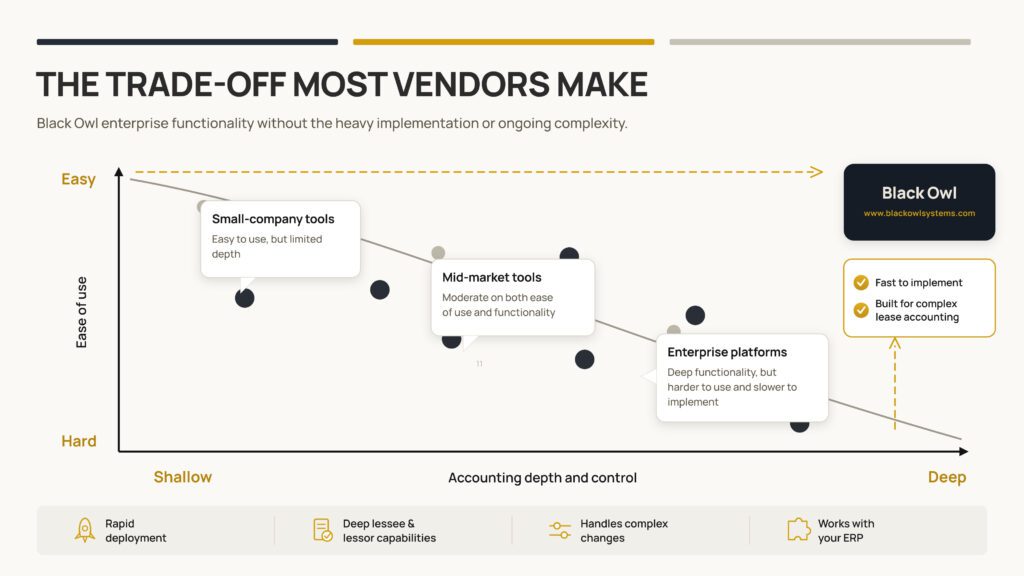
Black Owl is the only platform that supports ASC 842, IFRS 16, and ASPE 3065 together. One lease record can produce schedules, journal entries, and disclosures for all three at once.
Black Owl calculates every journal entry at lease inception and locks it in the database. There is no month-end posting run, so the full entry history is auditable from day one. Modifications and reassessments for current and retroactive periods post in under a minute.
For multinational reporting, it automatically imports daily FX rates and handles cumulative translation adjustments. It runs on single-tenant AWS hosting and includes unlimited users and entities in the price. A CPA-led team implements it in weeks, not months. It holds SOC 1 and SOC 2 Type 2 certifications.
However, Black Owl does not cover GASB, so government teams will need to look for purpose-built solutions.
2. NetLease by Netgain
Best for: Companies running NetSuite that want a native lease accounting solution.
NetLease is lease accounting built natively inside NetSuite, developed by former Big Four accountants. It posts journal entries directly in NetSuite, so lease data and the general ledger live in one system. A standalone version runs outside NetSuite for teams on other systems.
Standards: ASC 842, IFRS 16, GASB 87/96, FRS 102. Lessee, lessor, and sublease accounting.
Ratings: G2 4.8/5 (187 reviews) · Capterra 5.0/5 (49 reviews), as of July 2026.
Key features:
- Embedded in NetSuite for direct general ledger posting, with a standalone any-ERP version
- Automated amortization schedules, ROU asset tracking, and push-button disclosures
- Automated modifications, reassessments, and early terminations with recalculation
- AI-powered lease abstraction and multi-book, multi-currency support
Pros:
- Reviewers say it turns manual month-end lease reconciliation into a one-button process (G2).
- Because it is embedded in NetSuite, users describe the implementation and daily use as low-friction (G2).
Cons:
- Reviewers flag sublease accounting and some reporting as areas to improve (G2).
- Full reporting and auto-posting require the upgraded tier (G2).
Pricing: Quote-based for the NetSuite version. The standalone any-ERP version has a free tier and a paid plan from about $888 per year (Capterra).
3. FinQuery (formerly LeaseQuery)
Best for: Mid-market and enterprise teams that want broad standard coverage and a deep education engine.
FinQuery, formerly LeaseQuery, is a cloud-based lease subledger for mid-market and enterprise teams. It supports a broad standard set and pairs an AI inbox with a large education library. It does not offer lessor accounting or ASPE 3065.
Standards: ASC 842, IFRS 16, GASB 87/96, FRS 102, SFFAS 54. Lessee only. No ASPE 3065.
Ratings: G2 4.6/5 (530 reviews) · Capterra 4.6/5 (104 reviews), as of July 2026.
Key features:
- CPA-approved journal entries, amortization schedules, and disclosure reports
- AI-enabled lease data entry and an ERP-agnostic subledger with a native NetSuite build
- Automated remeasurement of the lease liability and ROU asset for CPI and variable changes
- Portfolio dashboard with alerts for expiring leases and critical dates
Pros:
- Reviewers repeatedly praise the intuitive interface that simplifies lease management (G2).
- Users highlight fast, knowledgeable support with live office hours (G2).
Cons:
- Some reviewers note missing modeling tools and a custom-report builder that feels limited (Capterra).
- Navigation can be confusing for infrequent users (Capterra).
Pricing: Quote-based on lease volume and features. For a full breakdown, see our comparison of FinQuery and Black Owl.
4. Visual Lease
Best for: Enterprises managing real estate portfolios that also want ESG reporting.
Visual Lease is an enterprise lease accounting and lifecycle platform founded in 1999. CoStar Group acquired it in 2024, and it serves more than 1,500 organizations. It serves accounting and real estate teams, and it extends into ESG reporting.
Standards: ASC 842, IFRS 16, GASB 87/96, FRS 102. Lessor present but not marketed. No ASPE 3065.
Ratings: G2 4.4/5 (381 reviews) · Capterra 4.7/5 (55 reviews), as of July 2026.
Key features:
- Purpose-built lease subledger for ASC 842, IFRS 16, and GASB compliance
- Large library of report templates with one-click roll-forward and disclosure reports
- Highly configurable data fields and bulk upload for large portfolios
- Critical-date alerts, document management, and auditor access controls
Pros:
- Reviewers value the organized interface for day-to-day lease administration (G2).
- The bulk-upload feature is called out as a real time-saver when loading many leases (Capterra).
Cons:
- Reviewers find the reporting and filtering confusing without training (Capterra).
- Some users report friction connecting to their ERP and mapping the general ledger (Capterra).
Pricing: Quote-based on business size and needs.
5. Nakisa
Best for: Large SAP or Oracle enterprises with high-volume, multi-entity portfolios.
Nakisa is an enterprise platform spanning lease accounting, real estate, and workforce planning. It suits large SAP or Oracle shops with complex, multi-entity portfolios. It supports both lessees and lessors, but its public review base is small.
Standards: ASC 842, IFRS 16, local GAAP. GASB and ASPE 3065 not confirmed. Lessee and lessor.
Ratings: G2 3.8/5 (2 reviews) · Software Advice 3.9/5 (20 reviews), as of July 2026.
Key features:
- Contract- and asset-level accounting for portfolios from hundreds to millions of contracts
- Native bidirectional integration with SAP, Oracle, and Workday
- Automated indexation, multi-currency FX translation, and non-standard calendars
- Decision Intelligence layer for scenario modelling
Pros:
- A reviewer credits the out-of-the-box SAP integration and flexibility for ASC 842 and IFRS 16 (G2).
- Reviewers value responsive support and an interface built for global portfolios (Software Advice).
Cons:
- Reviewers report bugs and stability issues in earlier or on-premise versions (Software Advice).
- One reviewer describes onboarding as complex and issue resolution as slow (Software Advice).
Pricing: Quote-based on portfolio size, deployment, and integrations.
6. Trullion
Best for: Finance teams that want AI-powered lease abstraction and audit-ready reporting.
Trullion is an AI-native accounting platform that entered through lease accounting. Its core is document intelligence, i.e., AI extracts lease data and drafts journal entries. It covers ASC 842, IFRS 16, and GASB 87, but not ASPE 3065.
Standards: ASC 842, IFRS 16, GASB 87, FRS 102. Partial lessor. No ASPE 3065.
Ratings: G2 4.7/5 (62 reviews) · Capterra 4.8/5 (13 reviews), as of July 2026.
Key features:
- AI and OCR extraction of key lease data from PDF and Excel contracts
- Trulli AI agent that answers questions and surfaces anomalies
- Source-linked audit trail that traces every data point to the contract
- Integrated IBR engine across regions, asset classes, and currencies
Pros:
- Reviewers consistently praise how easy the software is to use, often without formal training (Capterra).
- Users highlight fast implementation and hands-on rollout support (Capterra).
Cons:
- A reviewer notes the reporting section lacks a standalone roll-forward report (Capterra).
- Some users report that leases with multiple renewals behave unexpectedly and that SAP syncing could improve (Capterra).
Pricing: Quote-based, not public.
7. LeaseAccelerator
Best for: Large, global enterprises managing complex lease portfolios and procurement.
LeaseAccelerator is an enterprise lease lifecycle and accounting platform founded in 2003. insightsoftware acquired it in July 2024, and it targets Fortune 500 portfolios. It adds a lease sourcing marketplace and scenario modelling for procurement teams.
Standards: ASC 842, IFRS 16, GASB 87. No ASPE 3065. Lessee and lessor (lessor limited).
Ratings: G2 4.1/5 (111 reviews) · Capterra 5.0/5 (1 review), as of July 2026.
Key features:
- End-to-end lease lifecycle management, including termination, restructuring, and buyouts
- Certified ERP connectors for SAP, Oracle, Microsoft, and NetSuite
- Scenario modelling for lease-versus-buy and end-of-term decisions
- Roll-forward analytics with drill-down and audit-ready disclosures
Pros:
- Reviewers say it automates ASC 842 and exports finished entries straight to the ledger (G2).
- Users value the control and oversight it gives over lease records (G2).
Cons:
- Reviewers report the platform is slow, with report generation that can time out (G2).
- Support is mostly email-based, with no live chat or phone (G2).
Pricing: Quote-based. Catalog listings show an indicative start near $20,000 per year (Capterra).
8. EZLease
Best for: Smaller organizations that want fast, out-of-the-box compliance for lessee and lessor.
EZLease is a focused compliance tool for both lessee and lessor accounting. Now part of insightsoftware, it suits smaller teams that want quick setup with minimal configuration. A free tier covers a handful of leases, and larger portfolios are quote-based.
Standards: ASC 842, IFRS 16, GASB 87/96. No ASPE 3065. Lessee and lessor.
Ratings: G2 4.5/5 (17 reviews) · Capterra 4.6/5 (15 reviews), as of July 2026.
Key features:
- Full ASC 842, GASB 87/96, and IFRS 16 accounting with automated validation
- Separate lessee (with ARO) and lessor editions
- Self-service bulk import and configurable general ledger account mapping
- 15-plus reports, period locking, and multi-company, multi-currency support
Pros:
- Reviewers say it automates monthly entries and reconciliations that once ran in Excel (Capterra).
- Users praise ease of use and support at a price they consider low (Capterra).
Cons:
- Reviewers report that reports on large portfolios can run slowly (G2).
- Some users say service and usability slipped after the ownership change (Capterra).
Pricing: Free tier for 1 to 5 leases; larger portfolios are quote-based (G2).
9. Crunchafi (formerly LeaseCrunch)
Best for: CPA firms serving many clients under ASC 842 and GASB.
Crunchafi, formerly LeaseCrunch, is built around a shared firm-and-client dashboard. It automates journal entries, amortization schedules, and footnote disclosures for CPA firms. Per-lease pricing gives buyers a clear cost basis up front.
Standards: ASC 842, IFRS 16, GASB 87/94/96, FRS 102. No ASPE 3065. Lessee, with limited lessor.
Ratings: G2 4.8/5 (75 reviews) · Capterra 4.4/5 (15 reviews), as of July 2026.
Key features:
- Guided, wizard-based lease entry with in-app technical guidance
- Dual Access, i.e., a shared firm and client dashboard with role-based permissions
- AI lease abstraction that extracts key terms from a PDF
- Annual SOC 1 and SOC 2 Type II reports
Pros:
- Reviewers call it intuitive and well-guided, which reduces complexity for firms and clients (G2).
- Users praise support and value for the per-lease price (Capterra).
Cons:
- One reviewer reported incorrect amortization schedules that caused audit cleanup (Capterra).
- Some users experienced delays in report downloads (Capterra).
Pricing: Per lease, starting at $300 per lease, with a Professional tier at $2,000 for up to 8 leases and custom enterprise pricing (Crunchafi).
10. MRI ProLease
Best for: Real estate-heavy organizations needing integrated administration and accounting.
MRI ProLease is a lease administration and accounting platform for asset-diverse portfolios. It handles real estate and equipment in one system, with AI lease abstraction. Its strength is administration, so accounting depth trails a dedicated engine.
Standards: ASC 842, IFRS 16, GASB 87, FRS 102. GASB 96 not confirmed. Partial lessor.
Ratings: G2 4.1/5 (35 reviews) · Capterra 4.0/5 (48 reviews), as of July 2026.
Key features:
- Combined lease administration and accounting in one system
- Automated journal entries, amortization schedules, and disclosures across standards
- Critical-date alerts and workflow management
- AI lease abstraction to extract data from contracts
Pros:
- Reviewers call it user-friendly, with a logical flow that needs minimal training (Capterra).
- Users value that it calculates capitalization schedules, entries, and disclosures for ASC 842 (G2).
Cons:
- One reviewer reported the system could not produce reports their auditors needed for ASC 842 (Capterra).
- Reviewers say modules integrate poorly with each other and add cost (G2).
Pricing: Quote-based; catalog listings show an indicative start near $6,000 per year (Capterra).
11. Tango Lease
Best for: Retail and multi-location operators that want administration, accounting, and facilities together.
Tango Lease combines lease administration and accounting for large, multi-location portfolios. It fits retail and restaurant operators that also need facilities and site data. Its G2 profile is a blended suite score, so read reviews for the lease module.
Standards: ASC 842, IFRS 16, GASB 87. GASB 96 and ASPE 3065 not confirmed. Partial lessor.
Ratings: G2 4.3/5 (15 reviews) · Software Advice 4.0/5 (2 reviews), as of July 2026.
Key features:
- Generative-AI lease abstraction and document intake
- Automated ROU asset and lease liability calculations with GL-integrated entries
- Lease administration, i.e., critical dates, rent rolls, percentage rent, and CAM
- Integration with Tango’s broader real estate and site-selection suite
Pros:
- A reviewer says the ASC 842 schedules and accounting entries are straightforward and integrate with the general ledger (G2).
- Another reviewer chose Tango over 11 other products for its interface and reporting (G2).
Cons:
- One reviewer found the leasing system hard for new users and reported bugs in built-in reports (G2).
- Reviewers note a limited ad-hoc reporting tool and percentage-rent issues (G2).
Pricing: Quote-based, available on request (Software Advice).
12. DebtBook
Best for: Governments, higher education, healthcare, and nonprofits reporting under GASB.
DebtBook is purpose-built for governments, higher education, healthcare, and nonprofits. It covers GASB 87, GASB 96, and ASC 842, but not IFRS 16. It ties leases and subscriptions to debt and cash in one platform.
Standards: GASB 87/96, ASC 842. No IFRS 16, ASPE 3065, or FRS 102. Partial government lessor.
Ratings: Capterra 4.9/5 (16 reviews). No usable G2 rating yet, as of July 2026.
Key features:
- AI-assisted contract processing that extracts key data and suggests inputs
- Automated, GL-coded journal entry exports for ERP
- GASB 87 and ASC 842 audit notes and compliant disclosures
- One system of record across leases, SBITAs, debt, and contracts, with auditor access
Pros:
- Reviewers praise it as a centralized system for debt, leases, and SBITAs (Capterra).
- Customer service is a standout, with a real person answering in-app (Capterra).
Cons:
- Reviewers want more flexible reporting and custom schedules (Capterra).
- Ad hoc reporting is limited, and some edits still require the DebtBook team (Capterra).
Pricing: Quote-based, with Starter and Complete tiers for the lease and subscription module (DebtBook).
13. BlackLine
Best for: Enterprise finance teams automating reconciliations and the close.
BlackLine is a financial close and reconciliation platform, not a native lease engine. For leases, it reconciles a subledger such as CoStar against the general ledger. It suits enterprise teams that want lease data inside a controlled close.
Standards: Lease standards via a partner subledger (e.g., CoStar). No native lease engine.
Ratings: G2 4.5/5 (1,068 reviews) · Capterra 4.3/5 (19 reviews), as of July 2026.
Key features:
- Automated balance-sheet reconciliations with documentation and approval workflows
- High-volume transaction matching between the general ledger and subledger
- Journal entry creation, review, and posting to the general ledger
- Subledger integration that imports lease and other detailed data via API
Pros:
- Reviewers say loading subledger data into BlackLine transforms month-end reconciliation (G2).
- Users call it the best tool at month-end for getting accounts reconciled before audits (Capterra).
Cons:
- Reviewers report data-sync lag that can slow reconciliations near deadlines (Capterra).
- Some users find the interface clunky and dated (Capterra).
Pricing: Quote-based, sold by demo.
14. FloQast
Best for: Accounting teams automating close management and reconciliations.
FloQast is a close management platform that automates reconciliations and checklists. For lease accounting it partners with FinQuery, which runs the lease calculations. It fits accounting teams that want a structured, well-documented close.
Standards: Lease standards via the FinQuery partnership. No native lease engine.
Ratings: G2 4.6/5 (1,411 reviews) · Capterra 4.9/5 (106 reviews), as of July 2026.
Key features:
- Close management with centralized checklists, task tracking, and sign-offs
- Automated reconciliations that pull general ledger balances from the ERP
- Audit trail with timestamped actions, review notes, and approvals
- Native integrations with NetSuite, Sage Intacct, Dynamics, SAP, and Xero
Pros:
- Reviewers say it helps track tasks and keep amortization schedules organized (Capterra).
- Users value the intuitive interface and quick setup for month-end (G2).
Cons:
- A reviewer wants more customizable fields and additional amortization methods (Capterra).
- Some users report reconciliation friction with rigid formats (G2).
Pricing: Quote-based, by company size and scope.
15. Sage Intacct
Best for: Growing companies that want lease compliance inside their core accounting.
Sage Intacct is a cloud financial platform with a native lease accounting module. The add-on calculates ROU assets, liabilities, interest, and depreciation, then posts to the ledger. It suits growing companies that want lease compliance inside their accounting system.
Standards: ASC 842, IFRS 16, FRS 102 native. GASB via marketplace partner. Lessee-focused.
Ratings: G2 4.3/5 (4,258 reviews) · Capterra 4.3/5 (687 reviews), as of July 2026.
Key features:
- Native lease accounting add-on for NPV, ROU asset, liability, interest, and depreciation
- Lease data synced to a dimensional chart of accounts and real-time dashboards
- Multi-entity consolidation and close automation
- Marketplace of 350-plus integrations for deeper lease needs
Pros:
- Reviewers praise customizable dashboards and real-time reporting (Capterra).
- The dimensional model and multi-entity consolidation streamline the close (Capterra).
Cons:
- Reviewers report a learning curve that often needs training (G2).
- New capabilities often arrive as separate paid modules, so cost creeps up (Capterra).
Pricing: Quote-based, by module and user count.
16. Workiva
Best for: Organizations that want lease data inside integrated financial and ESG reporting.
Workiva is a connected reporting and disclosure platform, not a native lease engine. It partners with Visual Lease, which acts as the system of record for lease calculations. It fits teams that want lease data flowing into financial and ESG reports.
Standards: Lease standards via the Visual Lease partnership. No native lease engine.
Ratings: G2 4.5/5 (2,149 reviews) · Capterra 4.4/5 (45 reviews), as of July 2026.
Key features:
- Connected data, i.e., a single source that cascades updates to all linked documents
- SEC and regulatory filing plus disclosure management
- Real-time collaboration, workflow, audit trails, and access controls
- Integrated financial, ESG, and GRC reporting in one platform
Pros:
- Reviewers value the connected-data model as a reliable source of truth (G2).
- Users praise the interface and real-time collaboration for team reporting (Capterra).
Cons:
- Reviewers report a steep learning curve that needs setup and training (G2).
- A reviewer notes you cannot review Excel formulas within the tool (Capterra).
Pricing: Quote-based, solution and consumption-based.
17. CoStar Real Estate Manager
Best for: Corporate occupiers and retailers managing large real estate portfolios.
CoStar Real Estate Manager is a lease administration and accounting platform for occupiers. It supports ASC 842, IFRS 16, and FRS 102 across real estate and equipment. GASB coverage comes through its sister product Visual Lease.
Standards: ASC 842, IFRS 16, FRS 102. GASB via Visual Lease. Subleases; lessor partial.
Ratings: G2 4.4/5 (367 reviews) · Capterra 4.4/5 (30 reviews), as of July 2026.
Key features:
- Automated lease classification, measurement, and audit-ready entries and disclosures
- One repository for real estate and equipment leases with multiple schedules per lease
- Managed integrations to SAP, Oracle, Workday, and NetSuite
- Ad-hoc reporting, dashboards, critical-date alerts, and SOC 1 and 2 security
Pros:
- Reviewers rate its combined administration and ASC 842 accounting as best in class (Capterra).
- Users highlight ease of use and strong reporting (G2).
Cons:
- Reviewers report slow performance with large data sets (G2).
- Reporting is hard to manipulate, and support response can be slow (Capterra).
Pricing: Quote-based; reviewers describe it as premium-priced.
18. Occupier
Best for: Commercial tenants and brokers managing leases as an occupier.
Occupier is lease administration and accounting software built for tenants and brokers. It covers ASC 842 and IFRS 16 and states plainly that it does not handle lessor accounting. It fits real estate, finance, and legal teams that manage leases as a tenant.
Standards: ASC 842, IFRS 16, GASB 87, FRS 102. No ASPE 3065. Lessee only.
Ratings: G2 4.5/5 (184 reviews) · Capterra 4.6/5 (19 reviews), as of July 2026.
Key features:
- End-to-end lease administration with a central repository and clause tracking
- Critical-date alerts for renewals, rent increases, and expirations
- ASC 842 and IFRS 16 schedules, entries, and disclosure and roll-forward reports
- Deal and transaction management, plus AI lease abstraction
Pros:
- Reviewers repeatedly praise the clean, intuitive interface (G2).
- Users commend the hands-on support and implementation team (Capterra).
Cons:
- Reviewers find reporting limited, and exports arrive by email rather than direct download (G2).
- There is no mobile app, and some users report excessive email notifications (G2).
Pricing: Quote-based, per lease and per module; catalog listings show an indicative start near $3,500 per year (Capterra).
19. Spacebase
Best for: Mid-market teams that want lease administration and accounting with an open API.
Spacebase is a lease administration and accounting platform with an open API. It automates month-end close, journal entries, and disclosures for ASC 842 and IFRS 16. The evidence points to lessee-side accounting, so confirm any lessor need.
Standards: ASC 842, IFRS 16, GASB 87. ASPE 3065 not confirmed. Lessee.
Ratings: G2 4.5/5 (76 reviews) · Capterra 4.8/5 (37 reviews), as of July 2026.
Key features:
- Automated month-end close generating entries, schedules, and reports
- ROU asset and lease liability calculations for operating, finance, and short-term leases
- Exportable journal entries and disclosure reports
- Open-API integrations with NetSuite, Oracle, SAP, and Sage Intacct, plus multi-currency
Pros:
- A reviewer calls it a great, easy-to-use product for ASC 842 accounting (G2).
- Reviewers say support resolves issues quickly (Capterra).
Cons:
- Reviewers report limited self-serve custom reporting, so some reports need support (Capterra).
- Some users find the interface busy and note there is no bulk modification (Capterra).
Pricing: Quote-based, by portfolio size and features.
20. Rubli
Best for: Lessees and lessors that want IFRS 16, ASC 842, and FRS 102 with strong support.
Rubli is a cloud lease accounting tool built by accountants for lessees and lessors. It supports IFRS 16, ASC 842, and FRS 102 with multi-entity reporting. Reviewers single out its support team, though its independent review base is small.
Standards: ASC 842, IFRS 16, FRS 102. No GASB or ASPE 3065. Lessee and lessor.
Ratings: G2 4.8/5 (45 reviews) · Capterra 4.0/5 (1 review), as of July 2026.
Key features:
- Automated depreciation, interest, and period-end journals in ERP-ready formats
- Instant modifications and remeasurements without restating prior periods
- Full audit trail with version control, auditor access, and period locking
- Multi-entity, multi-currency accounting with FX translation and consolidation
Pros:
- Reviewers say its automation removes much of the manual lease work (G2).
- A reviewer rates its customer support 5.0 and calls it their preferred tool (Capterra).
Cons:
- A reviewer says early lease terminations are hard to correct without support (Capterra).
- Independent review validation is thin, with only one Capterra review and no free trial (Capterra).
Pricing: Quote-based, by number of users and leases.
21. Xero
Best for: Small businesses that need basic accounting with simple lease tracking.
Xero is general-purpose cloud accounting software, not a lease accounting engine. Landlords and small businesses use it for rent, invoicing, and bank reconciliation. Lease-standard compliance needs a third-party add-on such as LeaseGuru.
Standards: No native lease engine. ASC 842 and IFRS 16 require add-ons.
Ratings: G2 4.4/5 (1,600 reviews) · Capterra 4.4/5 (3,290 reviews), as of July 2026.
Key features:
- Recurring invoices and bills to schedule rent charges or payments
- Fixed asset register with automated depreciation
- Bank reconciliation with direct bank feeds
- App marketplace connecting to lease add-ons such as LeaseGuru and SOFT4Lessee
Pros:
- Reviewers praise the intuitive interface for day-to-day bookkeeping (G2).
- Users value the large app marketplace and integrations (G2).
Cons:
- Reviewers find reporting limited and inflexible for complex needs (G2).
- It is not built for lease-standard compliance, so it needs an add-on (Xero Community).
Pricing: Tiered (US): Early $25, Growing $55, Established $90 per month (Xero).
22. iLeasePro
Best for: Small and mid-sized businesses that want cost-effective ASC 842 compliance.
iLeasePro is a budget-friendly ASC 842 tool for small and mid-sized businesses. It automates amortization and journal entries and integrates with Sage Intacct. It does not support IFRS 16 or multi-currency, so it fits US GAAP single-currency use.
Standards: ASC 842. No IFRS 16, GASB (verify), ASPE 3065, or FRS 102. Lessee.
Ratings: G2 4.0/5 (13 reviews) · Capterra 5.0/5 (2 reviews), as of July 2026.
Key features:
- Automated daily amortization of ROU assets and monthly journal entries
- ASC 842 classification wizard and audit-ready disclosure reporting
- Native Sage Intacct integration for general ledger posting
- Document, critical-date, and contact management with unlimited users
Pros:
- Reviewers say the Sage Intacct integration uploads entries into the ERP cleanly (G2).
- Users find it markedly cheaper than competitors and simple for a complex topic (Capterra).
Cons:
- Reviewers say reporting is generic and not very customizable (G2).
- It does not offer multi-currency or IFRS, limiting it to US GAAP (Capterra).
Pricing: Tiered, from $99 per month; annual plans from about $2,400 per year for up to 25 leases (iLeasePro).
23. Leasecake
Best for: Multi-location operators and franchises that value simplicity and reminders.
Leasecake is a lease management and accounting platform for multi-location operators. It centralizes leases, licenses, and dates, and produces an ASC 842 import file. It fits franchises and multi-unit brands, and it focuses on the tenant side.
Standards: ASC 842, IFRS 16. GASB 87 partial. No ASPE 3065. Lessee.
Ratings: G2 4.7/5 (197 reviews) · Capterra 5.0/5 (23 reviews), as of July 2026.
Key features:
- Unified lease administration and accounting on one data model
- ASC 842 and IFRS 16 monthly import file and audit-ready disclosures
- Critical-date reminders for renewals, options, insurance, and permits
- AI lease abstraction and integrations with QuickBooks, NetSuite, and Sage Intacct
Pros:
- A reviewer says the monthly ASC 842 file saved an estimated 100-plus hours over 18 months (Capterra).
- Users value centralized leases, licenses, and permits with automated reminders (Capterra).
Cons:
- Reviewers want more custom reporting options (Capterra).
- Locations cannot be deleted, only archived, which some users find awkward (Capterra).
Pricing: Quote-based, by business size and needs.
What about AI-powered lease accounting software?
AI-powered lease accounting software uses artificial intelligence to read lease documents and pull the terms into your records. Most of the AI in this category does one job, i.e., lease abstraction. The software scans a PDF lease, then extracts the dates, payments, and options with OCR. A few tools add an AI assistant or an analytics layer for scenario modelling.
There are three kinds of AI you will see in these tools.
- Lease abstraction (document extraction). AI reads a lease and drafts a record from the key terms. This is the most common AI feature and the biggest time-saver for large or messy portfolios.
- AI assistants and agents. A chat layer answers questions about your lease data or the standards. Examples include Trulli from Trullion and Finn from LeaseAccelerator.
- Decision intelligence. An analytics layer models the balance-sheet impact of lease decisions, e.g., Nakisa’s Decision Intelligence module.
AI abstraction is much faster for getting data in. The risk is in what the AI actually reads. An extraction error on a variable payment or an embedded lease flows into every future journal entry. So what matters is how the tool behaves when the AI reads a clause wrong.
This is why even AI-native vendors now stress auditable AI. Trullion, for example, ties every output back to the source document for review. The lesson for buyers is to separate AI data entry from the accounting engine underneath. The engine is what your auditor traces years later, so it must be deterministic and verifiable.
Black Owl does not use an AI abstraction layer today. It loads data through the front end, a mass upload template, and APIs. Built-in validations catch errors before a lease is created. Every journal entry is then calculated at inception and locked in the database. The result is deterministic, i.e., the same inputs always produce the same outputs.
That is a deliberate choice for audit-sensitive teams, and it is also a real tradeoff. If you want AI to auto-read a stack of scanned PDFs today, Black Owl does not do that yet. If you want a calculation engine that an auditor can trace with no hidden steps, it fits.
Where Black Owl stands out, and why it matters
A few structural differences set Black Owl apart from the tools above. Each one maps to a specific need for the finance team.
Native lessee and lessor accounting
It handles sales-type, direct financing, and operating leases under ASC 842 and IFRS 16. FinQuery has no lessor module, so it covers only the tenant side. Occupier states plainly that it does not handle lessor accounting. Visual Lease, Nakisa, and Trullion treat the lessor side as partial or unmarketed. If you also act as a lessor, you avoid buying a second system.
A few structural differences set Black Owl apart from the tools above. Each one maps to a specific need for the finance team.
ASC 842, IFRS 16, and ASPE 3065 in one platform
No other tool in this guide supports ASPE 3065. For a Canadian private company, this is the difference between one platform and a workaround.
Multi-standard on a single lease record
One lease produces US GAAP, IFRS, and ASPE schedules at the same time. Groups that report under more than one standard stop maintaining parallel records.
Deterministic, locked journal entries
Every entry is calculated at inception and locked in the database. There is no month-end posting run, and no AI interpretation layer to verify. Black Owl produces the same outputs from the same inputs every time.
Retroactive modifications in under a minute
Prior-period changes recalculate forward while preserving the original schedule. The original version stays intact in the database for audit history.
Fast, CPA-led implementation
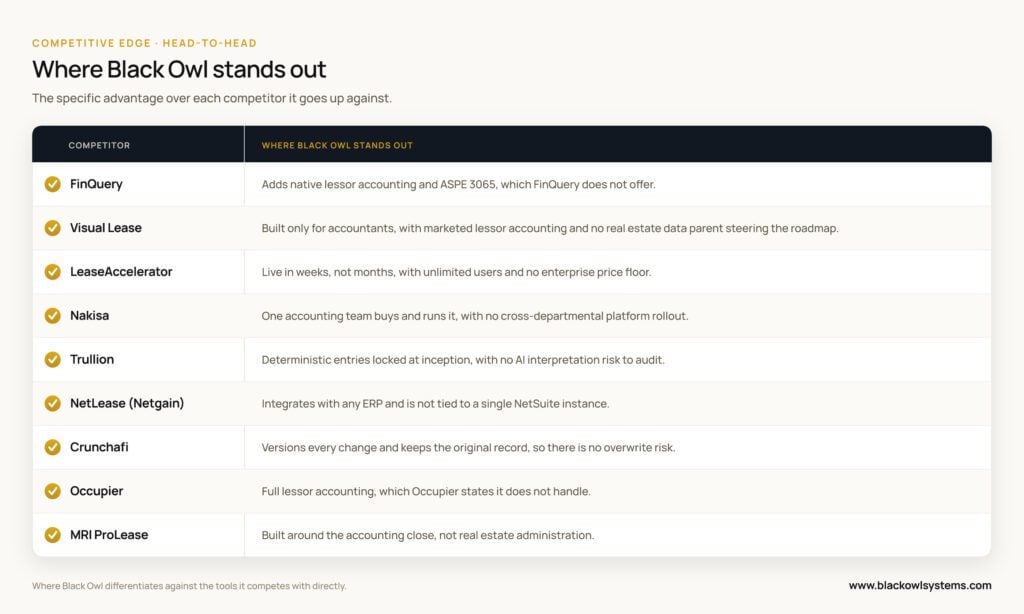
A CPA-led team implements Black Owl in weeks, not months. LeaseAccelerator and Nakisa run enterprise cycles measured in months across several departments.
The table below shows where Black Owl stands out against the tools it competes with directly.
Black Owl does not try to win every category in this guide. It does not cover GASB, real estate or facilities management, revenue recognition, or AI document extraction. For the lessee-and-lessor, multi-standard, fast-close use case, it is built to lead. You can see how its plans are structured or book a walkthrough.
How to choose lease accounting software
The best tool depends on your situation, not on a feature count. Weigh these eight factors before you shortlist.
1. Standards coverage
Match the tool to the standards you report under. US companies need ASC 842, and international groups need IFRS 16. Government teams need GASB 87 and 96. Canadian private companies need ASPE 3065, which almost no tool supports.
2. Lessee and lessor support
Confirm whether you are a lessee, a lessor, or both. If you sublease space or finance assets out to others, you need real lessor accounting. This is the most common gap, so check the owner side of the ledger directly in a demo.
3. Automation and the month-end close
Look at how the tool handles modifications, reassessments, and disclosures. The goal is fewer manual steps at close. Ask how a retroactive change is processed and whether prior periods stay intact.
4. Integrations
Your software should connect to your ERP or general ledger. NetSuite shops gain from a native build. SAP and Oracle estates need a strong integration layer. Confirm the exact journal entry workflow for your ERP version, not just that an integration exists.
5. Scale and multi-entity support
Smaller portfolios reward simple tools you can deploy fast. Large or multi-entity groups need multi-currency, consolidation, and strong performance on big portfolios. Ask how the tool performs when you run reports across thousands of leases.
6. Security and audit support
Lease data is sensitive financial information. Look for SOC 1 and SOC 2 reports, role-based access, and a full audit trail. Auditor access and a locked change history make year-end easier.
7. Implementation and support
Check how long implementation takes and who runs it. A CPA-led setup helps you go live before an audit deadline. Confirm what support looks like after go-live, i.e., a named team or a ticket queue.
8. Pricing model
Per-lease pricing is predictable for a stable lease count. Quote-based pricing suits larger or changing portfolios. Watch for per-user fees and charges for extra reports.
For the accounting background behind these criteria, read our guide to how lease accounting actually works. You can also weigh the spreadsheet route against purpose-built lease accounting software before you build a shortlist.
The bottom of line
The best lease accounting software matches your standard, your portfolio, and your lessee-or-lessor mix. You may account for leases as both a lessee and a lessor. You may report under more than one standard, or want to retire the spreadsheets without a long rollout. Black Owl is built for exactly that.
- Native lessee and lessor accounting under ASC 842, IFRS 16, and ASPE 3065
- Modifications, reassessments, and disclosures in minutes, with a full audit trail from day one
- ERP-ready, multi-entity, and multi-currency, and live in weeks
Frequently Asked Questions
What is the best lease accounting software?
The best lease accounting software depends on your size, your standard, and your lessor needs. Black Owl fits companies that need lessee and lessor accounting together, multi-standard reporting, or ASPE 3065. FinQuery and LeaseAccelerator suit large enterprises, NetLease suits NetSuite shops, Crunchafi suits CPA firms, and DebtBook suits government teams. Match the tool to your standard and lessor needs first.
How much does lease accounting software cost?
Lease accounting software usually costs between $1,000 and $10,000 or more per year. The total scales with your portfolio size and deployment model. Some vendors price per lease, e.g., Crunchafi from $300 per lease. Others publish tiers, e.g., iLeasePro from $99 per month. Enterprise tools like LeaseAccelerator are quote-based and can start near $20,000 per year. Expect to contact sales in most cases.
Which lease accounting tools handle lessor accounting?
Lessor support is less common than lessee support. Black Owl offers native lessor accounting, i.e., sales-type, direct financing, and operating leases. NetLease, EZLease, Nakisa, LeaseAccelerator, and Rubli also support lessor accounting to varying depths. FinQuery and Occupier do not offer it, and Visual Lease and Trullion treat it as partial. Confirm lessor depth in a live demo before you buy.
What is the best lease accounting software for ASPE 3065?
ASPE 3065 support is rare, and only Black Owl offers it here. It runs alongside ASC 842 and IFRS 16 on one platform. A Canadian private company can produce US GAAP, IFRS, and ASPE schedules from one lease. Other tools cover ASC 842 and IFRS 16 but leave ASPE out. That gap forces a spreadsheet workaround, so confirm current ASPE support with any vendor.
What is the best lease accounting software for small business?
Small businesses usually want a simple, fast-to-deploy tool without enterprise complexity. EZLease has a free tier for a handful of leases, and iLeasePro publishes low monthly pricing for ASC 842. Leasecake fits multi-location operators, and Black Owl scales down cleanly for growing teams and small businesses. Confirm whether you have any lessor or multi-currency needs before you decide, since the simplest tools often skip both.
What is the best lease accounting software for GASB 87?
GASB 87 support is available in DebtBook, FinQuery, EZLease, and Crunchafi. Most also add GASB 96 for subscription IT arrangements. DebtBook is purpose-built for the public sector and ties leases to debt and SBITAs. Black Owl does not cover GASB, so it is not the pick for public-sector reporting. Verify the SBITA workflow during a demo.
Can lease accounting software handle multiple leases and entities?
Lease accounting software is built to handle many leases across property, equipment, and vehicles. Most tools support bulk import, batch processing, and filtering by entity or department. Enterprise tools add multi-currency, cumulative translation adjustments, and consolidation across entities. If you run a large or multinational portfolio, test reporting speed on a full data set. Then confirm how the tool handles multi-currency and foreign exchange.
Does the tool matter for ASC 842 versus IFRS 16?
The tool does matter for ASC 842 versus IFRS 16, because the engine differs. US companies report under ASC 842 from the FASB, which keeps the finance and operating lease classes. International groups use the single model in IFRS 16 from the IASB. If you report under both, choose a tool with a true multi-standard engine. It should run both standards on one lease record. Black Owl runs ASC 842, IFRS 16, and ASPE 3065 together, which removes parallel records.
Is there free lease accounting software?
Free lease accounting software is rare in a complete form. Free options are usually spreadsheets, limited trials, or entry tiers, e.g., the EZLease free tier or LeaseGuru for two leases. They work for a few leases but lack the controls, audit trail, and automation that compliance needs. Most teams move to paid software once the portfolio grows past about ten leases.
What is the difference between lease accounting and lease management software?
Lease accounting software calculates the numbers, i.e., the right-of-use asset, lease liability, journal entries, and disclosures. Lease management software, sometimes called lease administration software, tracks documents, critical dates, and renewals. Many platforms do both, but the accounting engine is what your auditor relies on. Black Owl centers on the accounting side and adds lease management around it. See our guide to lease management versus lease accounting.

Greg Kautz
http://blackowlsystems.comGreg Kautz, CPA, CMA is a seasoned management consultant and professional accountant with over 40 years of experience in the consulting and energy sectors. At Black Owl Systems, Greg brings deep expertise in ERP systems, corporate finance, strategic planning, and technology integration.
