
How Much Does Lease Accounting Software Cost? A 2026 Pricing Guide
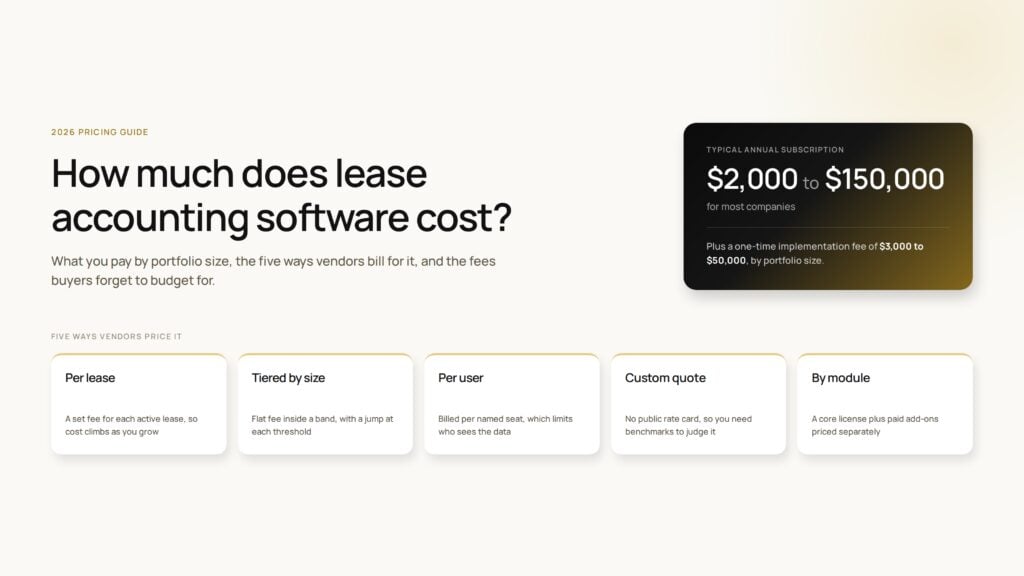
Lease accounting software usually costs between $2,000 and $150,000 per year. The price depends on your lease count, standards, and vendor. Small portfolios often pay $2,000 to $25,000 a year. Large or multi-entity portfolios can pass $50,000, plus a one-time implementation fee.
That range is wide because vendors price the same software very differently. Some charge per lease, some per user, and some by company size. Most do not publish a public rate card at all.
This guide explains how lease accounting software is priced in 2026. It covers what you pay by portfolio size, the fees buyers forget, and how to compare vendors. We use real market figures where they exist, and we flag each one for review.
One quick note on terminology will help before we go further. Pricing here means what a vendor charges to license the software. It does not mean how you account for lease payments under a standard.
How much does lease accounting software cost in 2026?
Most companies pay between $2,000 and $150,000 per year for lease accounting software. Your place in that range depends mostly on how many leases you manage. Your standards, entities, and integrations move the number up or down too.
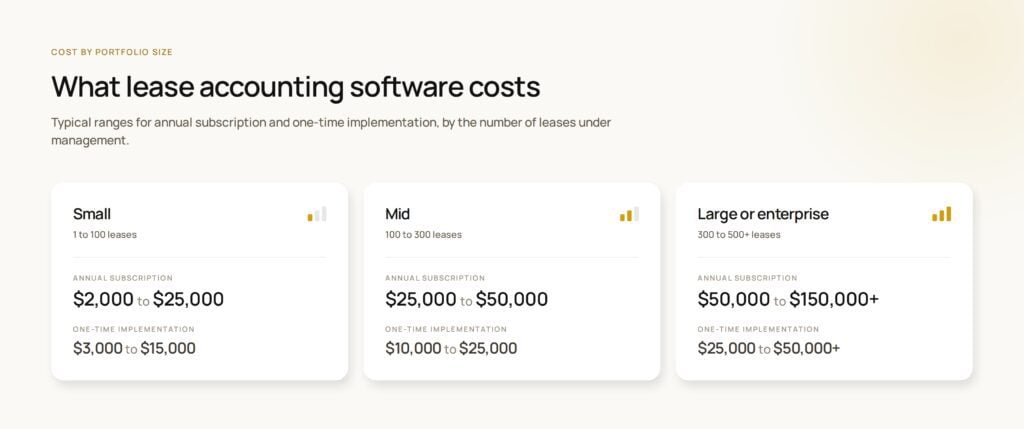
The table below shows typical annual pricing by portfolio size. Treat these as planning figures rather than firm quotes. Most vendors price custom, so your final number will vary.
These ranges come from vendor pages and third-party benchmarks.
Quotes vary because vendors weigh your portfolio and needs differently. The same 200-lease company can receive very different proposals. That is why benchmarking two or three vendors is worth the effort.
Most subscriptions include the core calculations, journal entries, amortization schedules, and disclosure reports. Confirm that reports and templates are included, and not billed as extras.
How lease accounting software is priced
Lease accounting software is sold five ways: per lease, tiered by company size, per user, custom quote, or by module. Most vendors combine two of these.
The pricing model matters as much as the headline number. Two vendors can quote the same total and bill it very differently. Here are the five models you will see, and what each means for your budget.
Per-lease pricing
Per-lease pricing charges a set fee for each active lease. As an example model, some vendors charge about $150 to $300 per lease per year. Effective rates often fall as your lease count grows.
This model is simple and cheap for a handful of leases. The cost climbs steadily as your portfolio grows, though. A team that adds leases each quarter pays more each quarter. Ask whether the count is based on active leases or all leases ever entered. That definition can change your bill by a wide margin.
Tiered by company size
Tiered pricing sets bands by portfolio or company size. Common bands run 1 to 50, 51 to 200, and 200-plus leases. You then pay a flat fee within each size band.
This model is predictable inside a band, but the jump between bands is the risk. Adding one lease over a threshold can push you into a higher tier.
Custom quote
A custom quote means the vendor publishes no public price. You request a demo, then receive a tailored proposal, as most enterprise vendors do.
Custom pricing can fit complex needs well, but the downside is a lack of transparency. You need benchmark figures to judge whether a quote is fair.
Module-based pricing
Module-based pricing sells a core product plus paid add-ons. A vendor may price lease accounting, subscriptions, and fixed assets separately. Bundles are common, but they can hide the cost of each piece.
Ask what the base license includes before you add modules. Confirm which features are core and which cost extra.
What drives the price
Several factors move a lease-software quote up or down. Knowing these factors helps you predict your own quote in advance. It also shows you where to push in a negotiation.
- Portfolio size. More leases mean a higher fee under almost every pricing model.
- Standards. Support for ASC 842, IFRS 16, ASPE 3065, and GASB 87 can raise the tier.
- Entities and currencies. Multi-entity and multi-currency needs usually raise the total price.
- ERP integration. A deeper connection to your ERP system usually costs more.
- Lessor accounting. Full lessor support, i.e., net investment tracking, often sits in a higher tier.
- Support level. Priority or dedicated support is often a paid upgrade.
The hidden costs buyers miss
The subscription price is only one part of the total bill. Several other costs show up during setup and at renewal. Plan for these extra costs before you sign a contract.
- Implementation and data migration. Vendors charge a one-time fee to load and configure your leases. This often runs $3,000 to $50,000 by portfolio size.
- Training and onboarding. Some vendors add a fee for extra training sessions. Reported training costs reach $2,000 to $10,000 for larger teams.
- Renewal escalators. Many contracts raise the price 3% to 5% each year. Ask to cap or remove the escalator up front.
- Per-user creep. Under per-user pricing, each new seat you add raises the cost. A growing team can outgrow its software budget without noticing.
- Module add-ons. Features sold as modules add to the base fee. Confirm what the core license already includes before adding modules.
- Paid support. Priority support is sometimes billed as a separate line item. Check whether standard implementation and support is included free.
Add these layers together to find your total cost of ownership. That figure includes the subscription, implementation, training, and any yearly increases. The headline subscription price is rarely the number you actually pay.
Is lease accounting software worth the cost?
Price is only half of the buying decision here. The other half is what you avoid by leaving spreadsheets. That is where the real value tends to show up.
Spreadsheets carry real risk under ASC 842 and IFRS 16. A broken formula can misstate a right-of-use asset or lease liability. That error can trigger an audit finding or a restatement. The cost of a single restatement can dwarf years of software fees.
Software adds control, a full audit trail, and a faster month-end close. It keeps your journal entries and disclosures consistent every period. For most teams, that time and risk saving pays for the license.
A useful rule of thumb sits at about ten leases. At that point, manual tracking usually costs more time than the software costs in fees.
Software also helps most during audit season and quarter-end. Auditors can trace each number back to a source lease and entry. That saves your team from rebuilding support under deadline pressure.
As one example, Black Owl reports SOC 1 and SOC 2 assurance and a 4.7 Capterra rating. One private equity user tracks 13 companies and more than 200 leases in it.
How to budget and compare vendors
Use the same checklist for every vendor you evaluate. It keeps quotes comparable and surfaces hidden fees early, so ask each vendor the same questions.
- Is pricing per lease, per user, or by company size?
- What does the base license include, and what costs extra?
- What is the one-time implementation fee, and what does it cover?
- What is the annual renewal escalator, and can you cap it?
- Which standards and ERP integrations are included in the quote?
- Are users and entities unlimited, or is there a per-seat cap?
- Is there a test environment, and how long is implementation?
Get every answer in writing before you compare totals. A low headline price can still hide costly add-ons. The cheapest quote is not always the lowest total cost.
Total cost of ownership, not the sticker price, is the right basis for comparison. Line up each vendor’s subscription, implementation, and renewal terms side by side.
Where Black Owl Systems fits
Black Owl Systems prices by number of leases, not company size or numbe rof users. Every plan includes unlimited users and entities, plus free support.
That pricing model protects your budget as the company grows. Adding another company or a teammate does not a price change. You move up a tier only when the size of your portfolio increases.
Black Owl offers plans for companies and for CPA firms. The company plans run from Small Business to Large Companies to Enterprise. The firm plans run from CPA Essentials to CPA Advanced.
Every tier covers lessee and lessor accounting under ASC 842, IFRS 16, and ASPE 3065. Higher tiers add a custom journal entry mapper, multi-currency, and ERP integration. Enterprise adds a test environment, advanced integrations, and multiple accounting standards.
Free support matters because many vendors charge extra for it. Your team can reach help without a separate support contract.
Implementation is fast, i.e., about two to eight weeks in most cases. Small businesses can go live within weeks. In-house accounting experts guide you through the whole setup.
Black Owl does not lead every category, and this guide stays honest about that. For only a few leases, a simple per-lease tool can cost less. Black Owl also does not support the GASB standards for government entities.
You can see the current plans on the Black Owl pricing page. It also helps to read how it compares with FinQuery and Visual Lease.
See what Black Owl would cost you
Black Owl Systems keeps lease accounting costs predictable as you grow:
- Pricing by number of leases, with unlimited users and companies on every plan.
- Fast setup, i.e., most teams go live in four to eight weeks.
- Audit-ready records backed by SOC 1 and SOC 2 assurance.
See the current plans and tiers, or book a short demo to get a tailored quote.
Frequently Asked Questions
How much does lease accounting software cost?
Lease accounting software costs between $2,000 and $150,000 per year for most companies. Small portfolios of under 100 leases often pay $2,000 to $25,000. Mid-size portfolios pay $25,000 to $50,000, and large portfolios pay more. A one-time implementation fee applies on top, usually $3,000 to $50,000. Most vendors quote custom, so treat these as planning ranges
How is lease accounting software priced?
Lease accounting software is priced in five main ways. Vendors charge per lease, tiered by company size, per user, by custom quote, or by module. Many combine two models, such as a base tier plus per-lease fees. The model matters as much as the total, because it decides how your bill grows. Ask each vendor which model applies before you compare quotes.
What is a fair price for 100 leases?
A fair price for 100 leases depends on your standards, entities, and integrations. As a planning range, many mid-size buyers pay $25,000 to $50,000 per year. Implementation adds a one-time fee, often $10,000 to $25,000. Per-lease vendors may quote less for a simple portfolio. Get two or three quotes to benchmark before you decide.
Are there implementation or setup fees?
Implementation fees are common and separate from the subscription. Vendors charge a one-time fee to migrate data, configure the system, and train your team. Reported fees range from about $3,000 to $50,000 by portfolio size. Larger or more complex portfolios sit at the higher end. Ask for a fixed fee and a clear scope to avoid surprises.
What hidden costs should I watch for?
Hidden costs are the fees buyers miss in the first quote. Watch for renewal escalators of 3% to 5% each year. Watch for per-user charges, paid support, and separately priced modules. Data migration and extra training can also add to the total. Ask for every fee in writing before you sign the contract.
Is lease accounting software worth it versus spreadsheets?
Lease accounting software is usually worth it once you manage about ten leases. Spreadsheets carry real risk under ASC 842 and IFRS 16, since one broken formula can misstate a balance. Software adds control, an audit trail, and a faster month-end close. For most teams, the time and risk saving covers the license fee.
Is there free enterprise lease accounting software?
Lease accounting software is usually worth it once you manage about ten leases. Spreadsheets carry real risk under ASC 842 and IFRS 16, since one broken formula can misstate a balance. Software adds control, an audit trail, and a faster month-end close. For most teams, the time and risk saving covers the license fee.
Does pricing change for CPA firms?
Pricing for CPA firms usually works differently from company pricing. Firms are often billed by clients and users rather than by a single lease count. Some vendors offer dedicated firm tiers with multi-client management. Black Owl, for example, offers CPA Essentials and CPA Advanced plans as a model. Confirm the firm terms with the vendor directly, since packaging varies.
How is Black Owl Systems priced?
Black Owl Systems is priced by number of leases, not per user or company size. Every plan includes unlimited users and entities, plus free base support. Plans scale from Small Business to Enterprise, with CPA firm tiers as well. Black Owl does not publish numbers, so pricing comes through a custom quote. Book a demo with the vendor to get a tailored figure.
Can I try lease accounting software before I buy?
Trying lease accounting software before you buy is usually possible through a demo. Most vendors offer a guided demo, and some offer a free trial or a test environment. A demo lets you load a sample lease and see the reports. It also lets you confirm the standards and ERP integrations you need. Ask for a demo with your own data where possible.

Greg Kautz
Greg Kautz, CPA, CMA is a seasoned management consultant and professional accountant with over 40 years of experience in the consulting and energy sectors. At Black Owl Systems, Greg brings deep expertise in ERP systems, corporate finance, strategic planning, and technology integration.
