
I Have Spent 40 Years Watching Finance Teams Build Their Own Solutions. Here Is How It Always Ends
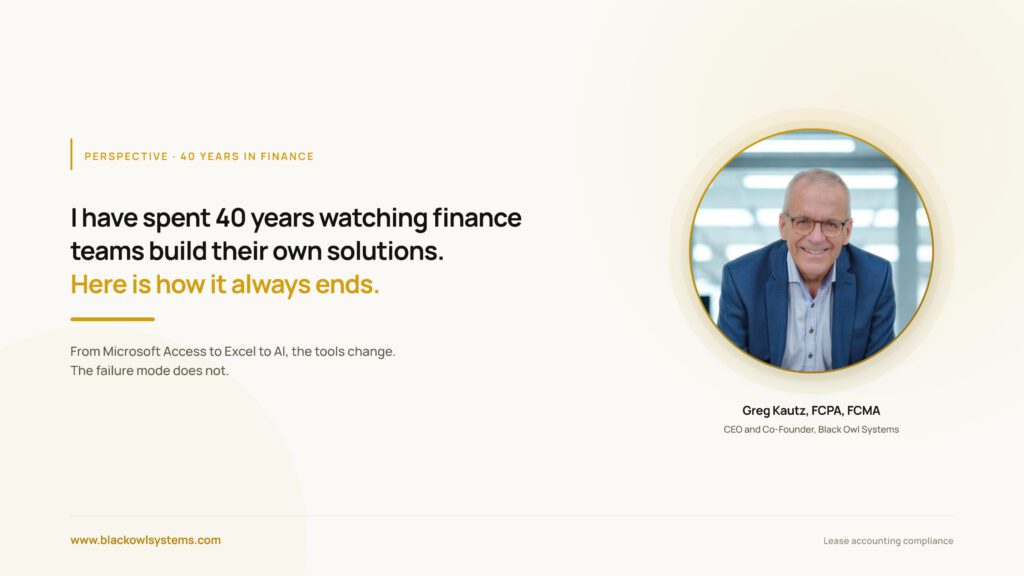
I started my accounting career as an auditor. In simple terms, my job was to find what was broken or wrong. And in the mid-1990s, one of the most reliable places to find broken things was wherever someone had built a finance solution in a spreadsheet.
I want to be clear – some of those solutions were often impressive. Genuinely clever work by smart people who understood the business and got frustrated waiting for someone else to solve their problem. They built GL sub-ledgers, cash flow models, AR aging tools. Some of them were elegant. I understood why people were proud of them.
But pride is not a control. And that is what I kept running into.
The tool was not the problem. The accountability gap was.
Greg Kautz, FCPA, FCMA - CEO and Co-Founder, Black Owl Systems Tweet
The Access Era: When the Builder Leaves, the Knowledge Leaves
As an internal auditor, I saw the same pattern repeat itself across organizations and industries. A finance team would build something in Access that worked — really worked — for their specific situation. It solved a real problem. It saved real time.
Then one of three things would happen. The person who built it would leave. The business would change in a way the tool was never designed to handle. Or an auditor — sometimes me — would ask a question about the underlying logic, and nobody in the room could answer it.
The tool had become load-bearing infrastructure with no documented foundation. The organization did not know what it did not know. And when it broke, it broke quietly — producing wrong numbers with complete confidence until someone noticed something was off.
I raised these concerns constantly. The response was almost always the same: resistance. The person who built it would defend it. The team that depended on it would defend it. Change is uncomfortable, and what was working — or appeared to be working — felt safer than the unknown.
Microsoft eventually stopped investing heavily in Access. The market moved on. But the lesson did not travel with it.
The Excel Era: Same Story, Different Decade
When I became a CFO, I had one firm rule about financial reporting: numbers pulled from the ERP, not consolidated in Excel.
This sounds obvious. It was not obvious to my teams. I fought this battle in every organization I led. Incredibly capable finance professionals, people I respected enormously, had built elaborate Excel models that they trusted completely. They knew every tab, every formula, every linked cell. It worked for them.
The problem was that it worked for them. Not for the organization. Not for the audit. Not for the next CFO, or the next controller, or the analyst who joined six months later and had to reverse-engineer three years of reporting logic from a spreadsheet with no documentation.
Excel is not the villain of this story. Excel is a remarkable tool. The villain is the belief that a tool you control is the same as a control environment. It is not. A spreadsheet is not a system of record. It is a system of one person’s record.
I still encounter Excel-based lease accounting models today. As recently as last year, I spoke with a company managing a large and genuinely complex lease portfolio in an Excel model with VBA automation. It was sophisticated work. The person who built it had since left the company. They were using AI to fix it when it broke.
I want to let that land for a moment. They were using the newest technology available to maintain a solution built on a previous generation of technology that had replaced the generation before that. The wheel was not moving forward. It was spinning.
A spreadsheet is not a control environment. It is a system of one person's record.
Greg Kautz, FCPA, FCMA - CEO and Co-Founder, Black Owl Systems Tweet
The AI Era: The Pattern Is Identical
A few weeks ago I received a message from an accounting firm we had recently given a demonstration to. They had been evaluating whether to recommend Black Owl to their clients for lease accounting compliance. Their response was polite and well-written. In summary: they had an internal AI and automation team developing solutions to serve their client population directly. They did not need a lease accounting platform, they would provide solutions using AI.
I read it twice. Then I thought about every Access conversation I had in the 1990s. Then I thought about every Excel conversation I had as a CFO.
The message was different. The logic was identical.
I am not writing this to dismiss AI. I have spent enough time in finance and technology to know that dismissing a tool because it is new is just as foolish as adopting one because it is new. AI is genuinely capable of remarkable things. It will absolutely change how lease accounting gets done over the next decade, and Black Owl is actively working on how to bring those capabilities to our clients in ways that are practical and compliant.
But here is what AI cannot do, and what no version of AI in its current form will be able to do by itself:
- AI cannot be SOC certified.
- AI cannot monitor FASB and IASB for standard changes and update the methodology accordingly.
- AI cannot own the answer when your auditor asks who is responsible for the lease accounting output.
- AI cannot handle a mid-term lease modification with a partial termination and a currency change at quarter close – not reliably, not auditably, not at enterprise scale.
These are not criticisms of AI. They are descriptions of what compliance actually requires. Compliance is not a build problem. It is an ongoing accountability problem. Someone has to own the interpretation, the updates, the audit defense, and the control environment. A tool — however powerful – cannot own those things. A person, or an organization, has to own it.
Why We Built Black Owl
I spent four decades watching organizations learn this lesson the hard way. When I was an internal auditor who documented the failures. When I was the CFO who fought the resistance. I watched the Access era end and the Excel era begin and the problems follow right along.
When my son and co-founder Derek and I started Black Owl, we were not building software. We were building the thing I always wished existed when I was sitting on the other side of the table – a platform that a CPA built, that thinks the way accountants think, that handles the complexity that actually exists in the real world, and that can stand up in front of an auditor without anyone breaking a sweat.
We listen to our clients. Deeply. Every capability we have built has come from sitting with finance leaders and asking what is actually hard. That is how we will approach AI as well – not because a press release requires us to say we have it, but because our clients tell us exactly what they need it to do.
The tools will keep changing. The accounting does not.
AI is great at building the first version. Lease accounting compliance requires someone to own every version after that.
By Greg Kautz, FCPA, FCMA - CEO and Co-Founder, Black Owl Systems Tweet
About the Author
Greg Kautz, FCPA, FCMA is the CEO and Co-Founder of Black Owl Systems, a lease accounting compliance platform serving mid-market through Fortune 500 companies. Greg spent 40+ years as a finance leader and internal auditor before building the solution he always wished existed.
Black Owl Systems — blackowlsystems.com

Greg Kautz
Greg Kautz, CPA, CMA is a seasoned management consultant and professional accountant with over 40 years of experience in the consulting and energy sectors. At Black Owl Systems, Greg brings deep expertise in ERP systems, corporate finance, strategic planning, and technology integration.
