
Straight-Line Depreciation: Formula and Example (2026)
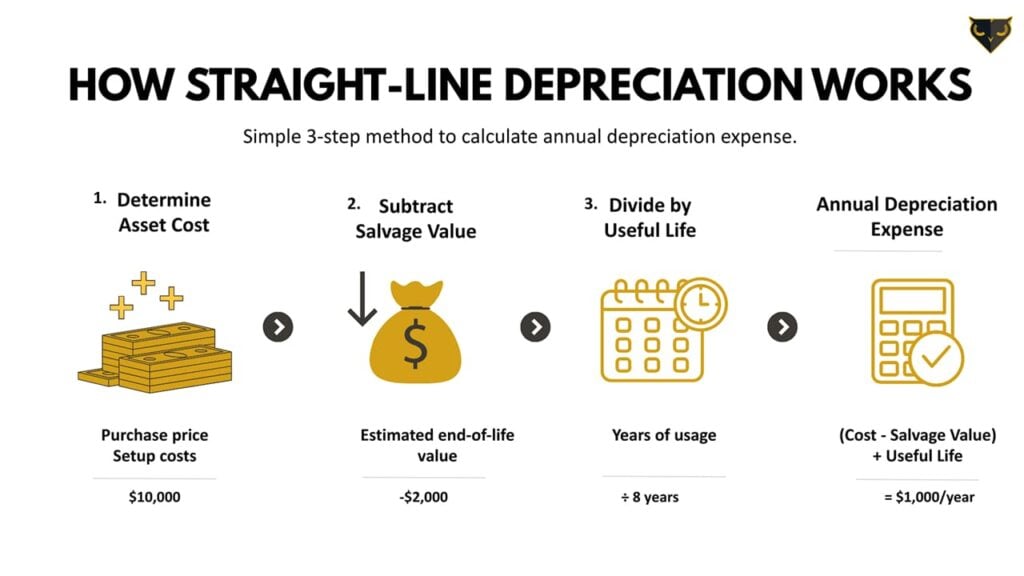
Quick definition: Straight-line depreciation is a method of allocating the cost of a tangible fixed asset evenly across its expected useful life. The formula is (Cost − Salvage Value) ÷ Useful Life, and the result is the same depreciation expense every year until the asset reaches its salvage value.
Straight-line is the simplest and most widely used depreciation method, and it’s the standard choice for office equipment, furniture, buildings, and most assets that lose value at a steady pace. It also shows up in lease accounting, since right-of-use assets under finance leases in ASC 842 and most leases under IFRS 16 are generally amortized on a straight-line basis. This guide covers the formula, a worked example with a full year-by-year schedule, the journal entry, how to handle partial years and changes in estimates, and how straight-line compares to accelerated methods.
What Is Straight-Line Depreciation?
Depreciation is the process of allocating the cost of a tangible fixed asset over the periods that benefit from its use. Rather than expensing a $10,000 piece of equipment the day it’s purchased, the company spreads that cost across the years the equipment helps generate revenue. This follows the matching principle of accrual accounting, where expenses are recognized in the same periods as the revenue they help produce.
Straight-line depreciation assumes the asset gives up an equal share of its value every year. That produces a constant annual expense, which makes it easy to calculate, easy to forecast, and easy for auditors to verify. For assets that wear out gradually and deliver roughly the same benefit each year, it’s also the most accurate reflection of how the asset is actually consumed.
Straight-Line Depreciation Formula
Annual Depreciation Expense = (Cost − Salvage Value) ÷ Useful Life
The formula has three inputs. Cost is the original purchase price of the asset plus any costs required to get it ready for use, such as delivery, installation, setup, and testing. Salvage value, also called residual value, is the amount the company expects to recover from the asset at the end of its useful life through sale or scrap. Useful life is the number of years the company expects to use the asset to generate economic benefits, which is based on the company’s own expectations and experience rather than the asset’s maximum physical lifespan.
Cost minus salvage value is known as the depreciable base, which is the total amount that will be expensed over the asset’s life. The same calculation can also be expressed as a rate. Dividing 1 by the useful life gives the annual straight-line depreciation rate, so an asset with an 8-year useful life depreciates at 12.5% of its depreciable base each year.
Straight-Line Depreciation Example
Suppose a company buys office equipment for $10,000, including setup costs. It expects to use the equipment for 8 years and sell it for $2,000 at the end of that period.
Annual Depreciation = ($10,000 − $2,000) ÷ 8 = $1,000 per year
The company records $1,000 of depreciation expense every year for 8 years. By the end of year 8, the equipment’s book value has dropped from $10,000 to its $2,000 salvage value, and depreciation stops.
Year-by-Year Book Value
| Year | Beginning Book Value | Depreciation Expense | Accumulated Depreciation | Ending Book Value |
|---|---|---|---|---|
| 1 | $10,000 | $1,000 | $1,000 | $9,000 |
| 2 | $9,000 | $1,000 | $2,000 | $8,000 |
| 3 | $8,000 | $1,000 | $3,000 | $7,000 |
| 4 | $7,000 | $1,000 | $4,000 | $6,000 |
| 5 | $6,000 | $1,000 | $5,000 | $5,000 |
| 6 | $5,000 | $1,000 | $6,000 | $4,000 |
| 7 | $4,000 | $1,000 | $7,000 | $3,000 |
| 8 | $3,000 | $1,000 | $8,000 | $2,000 |
Monthly and Partial-Year Depreciation
Most companies close their books monthly, so the annual figure is usually divided by 12. In this example, monthly depreciation is $1,000 ÷ 12 = $83.33.
Assets are rarely purchased on the first day of the fiscal year, so the first year is often a partial one. If the equipment above were placed in service on April 1 in a calendar-year company, year 1 would include 9 months of depreciation, or $1,000 × 9/12 = $750. The remaining $250 would then be recognized in a ninth calendar year, so the full $8,000 depreciable base is still expensed over exactly 8 years of use. Some companies simplify this with a convention, such as taking a half year of depreciation in the year of acquisition regardless of the purchase date. Whichever approach is used, it should be applied consistently across the asset register.
How to Calculate Net Book Value
Net Book Value = Original Cost − Accumulated Depreciation
Net book value, also called carrying value, is what the asset is worth on the balance sheet at any point in time. Under straight-line depreciation, it can be calculated for any year without building the full schedule. Multiply the annual depreciation by the number of years elapsed to get accumulated depreciation, then subtract that from cost. After 3 years, the equipment in the example has accumulated depreciation of $3,000 and a net book value of $10,000 − $3,000 = $7,000.
Net book value reflects historical cost less depreciation. It isn’t a measure of what the asset would sell for today, and the two can differ significantly, especially for assets like vehicles and technology that lose market value faster than their straight-line schedule assumes.
Straight-Line Depreciation Journal Entry
The journal entry to record straight-line depreciation is the same every period for the entire useful life of the asset. For the annual entry in the example:
| Account | Debit | Credit |
|---|---|---|
| Depreciation Expense | $1,000 | |
| Accumulated Depreciation | $1,000 |
To record annual straight-line depreciation on office equipment ($10,000 cost, $2,000 salvage value, 8-year useful life).
Depreciation expense is an income statement account that reduces net income for the period. Accumulated depreciation is a contra-asset account on the balance sheet, which means it offsets the asset’s original cost without changing the cost figure itself. Keeping the two separate lets anyone reading the financial statements see both what the company paid for its assets and how much of that cost has been used up. For a company that closes monthly, the same entry is recorded for $83.33 each month instead of $1,000 at year end.
If the asset is sold or retired before the end of its useful life, the company records depreciation up to the disposal date, removes both the asset’s cost and its accumulated depreciation from the books, and recognizes a gain or loss for the difference between the sale proceeds and the net book value. For more on how depreciation and amortization entries work alongside lease entries, see our guide to lease accounting journal entries.
Changing the Useful Life or Salvage Value
Useful life and salvage value are estimates, and estimates change. When they do, the change is accounted for prospectively. Past depreciation isn’t restated. Instead, the remaining net book value, less the revised salvage value, is spread over the revised remaining useful life.
Using the example, suppose that after 3 years the company decides the equipment will only last another 3 years instead of 5, with the same $2,000
Frequently Asked Questions
What is the formula for straight-line depreciation?
(Cost − Salvage Value) ÷ Useful Life. The result is the annual depreciation expense recorded each year until the book value of the asset equals its salvage value.
Why is straight-line depreciation the most common method?
It is the simplest to calculate, the easiest to audit, and accurately reflects assets that lose value evenly over time. It also simplifies tax compliance and financial reporting under standardized frameworks.
What is the difference between straight-line and accelerated depreciation?
Straight-line spreads cost evenly across the useful life. Accelerated methods (such as declining balance) front-load depreciation, recognizing more expense in early years and less in later years. Accelerated methods better match assets that lose value rapidly when new.
Does straight-line depreciation apply to leased assets under ASC 842?
Yes, in many cases. ROU assets under ASC 842 finance leases and under IFRS 16 are amortized straight-line over the shorter of the lease term or the asset’s useful life. Under ASC 842 operating leases, the ROU amortization is plug-balanced so that total lease expense is straight-line.
What is the journal entry for straight-line depreciation?
The annual entry is: Debit Depreciation Expense (income statement) and Credit Accumulated Depreciation (contra-asset on the balance sheet) for the calculated annual depreciation amount. The entry is repeated each year until the book value reaches the salvage value.
Can software automate straight-line depreciation?
Yes. Platforms like Black Owl Systems automate depreciation schedules, generate journal entries, post them to any ERP, and produce disclosures – across both fixed assets and ROU assets – in one platform.
Bringing it all together
Straight-line depreciation is the workhorse of fixed asset accounting and lease amortization. The formula is simple, the journal entries are repetitive, and the audit trail is straightforward – until you’re managing dozens of fixed assets and hundreds of leases with different start dates, useful lives, and modifications. That’s where the operational burden compounds and spreadsheet errors creep in.
If your team is still managing depreciation alongside lease accounting in spreadsheets, the next step is short: see how Black Owl unifies fixed asset depreciation and ROU asset amortization in one platform. The demo is 10 minutes.
Related resources

Greg Kautz
Greg Kautz, CPA, CMA is a seasoned management consultant and professional accountant with over 40 years of experience in the consulting and energy sectors. At Black Owl Systems, Greg brings deep expertise in ERP systems, corporate finance, strategic planning, and technology integration.
