
NetLease vs Black Owl Systems (2026): Which Wins?
NetLease by Netgain is a NetSuite-native lease accounting app that runs inside NetSuite. Black Owl Systems is a standalone lease accounting platform that connects to any ERP.
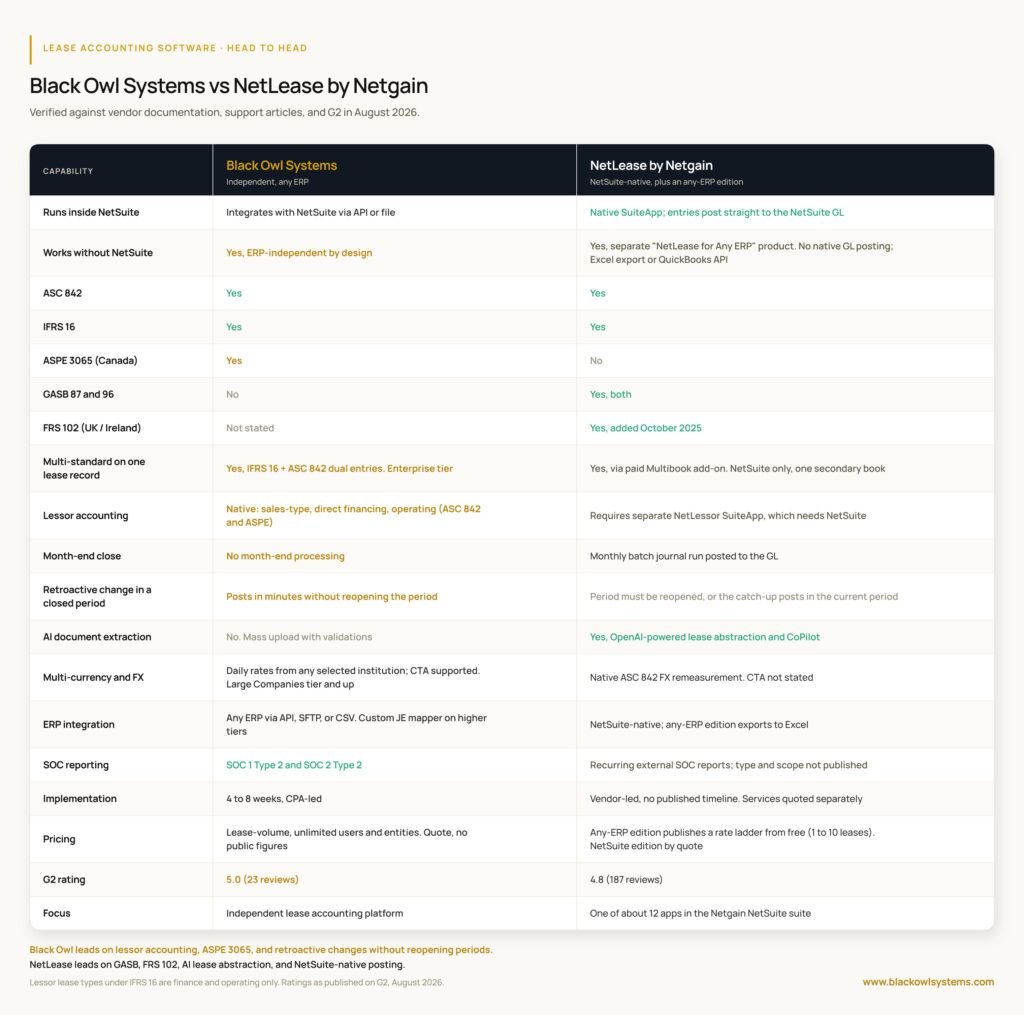
That one difference drives most of this whole comparison. Being on NetSuite is a requirement for one tool, and just an option for the other.
- Choose NetLease if you are a committed NetSuite shop and want lease accounting embedded in NetSuite.
- Choose Black Owl if you are not on NetSuite, need ASPE 3065, act as a lessor, or want multi-standard on one record, a no-month-end close, and transparent pricing.
NetLease vs. Black Owl Systems
Black Owl Systems explained
Black Owl Systems is a standalone lease accounting platform that calculates and locks every journal entry at inception. It supports ASC 842, IFRS 16, and ASPE 3065, for both lessees and lessors. To be clear, this is Black Owl Systems, the lease accounting platform. It is not Black Owl Capital or any similarly named brand.
Black Owl is a private company and was built by accountants, for accountants who own the close. It connects to whatever ERP you already run, including NetSuite. Its clearest difference is that it runs both sides of the lease in one system.
It holds SOC 1 Type 2 and SOC 2 Type 2, and runs on single-tenant AWS hosting. Pricing is transparent and lease-volume based, with unlimited users and entities. A CPA-led team takes most customers live in about 4 to 8 weeks. Named clients include AbbVie, and the CEO is Greg Kautz, FCPA.
NetLease by Netgain explained
NetLease by Netgain is a lease accounting app built as a NetSuite SuiteApp, so it runs inside NetSuite. It covers ASC 842, IFRS 16, and GASB 87.
First, a quick note to clear up the name. NetLease is lease accounting software, not a “net lease” or NNN real estate arrangement. Netgain is the company, and NetLease is its lease module. That module sits alongside other Netgain apps, such as NetAsset and NetClose.
Because NetLease lives in NetSuite, it posts journal entries directly in the NetSuite general ledger. That is a strong fit for finance teams already on NetSuite. It markets automation and AI features for lease data. NetLease holds a strong G2 rating, near 4.8 across about 187 reviews. Netgain even publishes its own NetLease-versus-FinQuery comparison page.
The NetSuite question: native app vs any-ERP platform
NetLease only runs inside NetSuite, while Black Owl runs as a dedicated system that connects to any ERP. So being on NetSuite is a requirement for one, and an option for the other.
NetLease is purpose-built to run and live inside NetSuite. Lease data and the general ledger sit in one system, and entries post directly. For a committed NetSuite shop, that is a real advantage. There is one login, and no separate system to reconcile.
That same design is a hard limit for everyone else. If you run SAP, Oracle, Microsoft Dynamics, or Sage, NetLease is not built for you. It is also a limit if you might switch ERPs later.
Black Owl is designed around the opposite approach instead. It integrates with any ERP through an API or secure file exchange, including NetSuite. It also stays independent of any single ERP roadmap. So the real question here is a simple one.
Should lease accounting live inside your ERP, or in a dedicated system that feeds it? Our guides cover whether lease accounting belongs inside your ERP at all. Another covers keeping lease data in sync with your ERP.
Accounting standards coverage
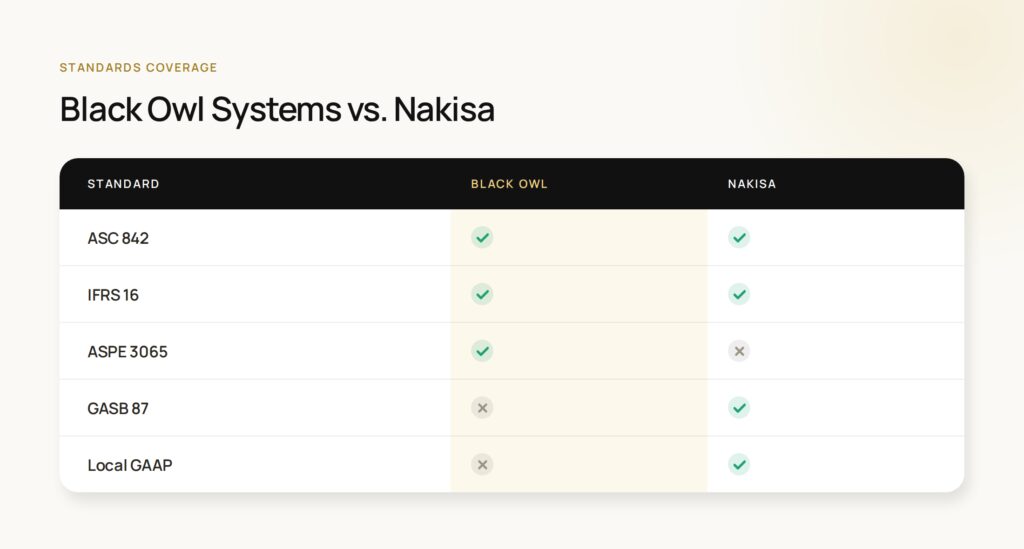
Both platforms cover the two standards most companies report under. Those are how the US standard actually works and IFRS 16. The differences that matter sit at the edges again.
Black Owl adds ASPE 3065, the Canadian private-company standard most tools skip. It also runs multi-standard reporting on one lease record. That means one lease can produce US GAAP, IFRS, and ASPE schedules at once. Multi-standard on one record removes duplicate data entry, and it keeps the schedules in sync.
NetLease adds GASB 87 support for public-sector entities. Black Owl does not cover GASB, on the other hand. So government teams should weigh NetLease on that point.
Lessee vs lessor accounting
Both platforms cover lessee accounting, i.e., the tenant side. Black Owl also markets full lessor accounting, which NetLease, being lessee-first, does not.
Most lease accounting software is built lessee-first by default. If you finance assets out to others, that focus can leave a gap. Black Owl markets full lessor accounting, including net investment tracking. That covers the separate entries a lessor records, which many tools skip.
NetLease centers on the tenant side, in line with its NetSuite finance focus. If a real share of your portfolio is leases you own out, test the lessor workflow on both. See how Black Owl runs both sides of the lease in one system.
The month-end close and audit trail
Black Owl approaches the close differently because of a core architectural decision: it calculates and locks all future journal entries when the lease is first recorded. As a result, finance teams do not need to manage a separate posting run at month-end.
When a lease is modified or reassessed, Black Owl recalculates the affected entries in under a minute. This applies to both current and retroactive periods, while each earlier version remains preserved for reference and audit purposes.
The result is a clear audit trail in which every journal entry can be traced back to the original lease terms and any subsequent changes. NetLease, by comparison, posts through the NetSuite close cycle, although the details of its calculation architecture are not publicly documented to the same extent.
Our guide explains why the month-end close is often where lease accounting platforms begin to differ. A live demonstration is also the best way to see how Black Owl builds, updates, and locks journal entries.
Automation and AI
Netgain markets both automation and AI features inside NetLease. Those features speed up data entry and routine lease tasks. That is real value for a busy finance team.
Black Owl takes a different path to the same goal. It uses a mass-upload template with built-in validations and no AI interpretation layer. As a result, its calculations stay deterministic and repeatable. The same inputs always produce the very same outputs. Both approaches cut manual work, but at different points. Automation speeds data entry, while deterministic validation removes interpretation risk on complex clauses.
Implementation, speed, and self-serve
Black Owl typically completes implementation within 4 to 8 weeks, with the process led by a team of CPAs. The platform can also be demonstrated in a single live session using the customer’s own data, while ongoing support is provided directly by accountants who understand the month-end close.
NetLease implementation is tied to the wider NetSuite environment. Some G2 reviewers point to a complex interface as well. One writes that it takes “additional effort to manage lease liabilities.” That is a verified review, not a claim from us, so weigh it fairly. You can also use a framework for scoring any lease platform to compare them.
Pricing and transparency
Black Owl prices the platform according to lease volume, with unlimited users and entities included. Inactive leases do not incur additional fees. Pricing can be discussed early in the buying process, without requiring a lengthy sales cycle, and Black Owl makes both its costs and pricing structure directly available.
NetLease uses SuiteApp licensing, which sits on top of a NetSuite footprint. So its total cost includes the NetSuite dependency, not just the lease app. We do not publish any invented competitor numbers here. On total cost of ownership, weigh the license, the NetSuite seats, the implementation, and the support.
What reviewers say
NetLease holds the larger review base of the two. It rates near 4.8 on G2, across about 187 reviews. That reflects a mature base within the NetSuite community. Black Owl holds a 5.0 on G2, across 16 reviews. Its base is smaller, since it is a newer platform.
One verified Black Owl reviewer is a private equity firm. It runs 13 operating companies and more than 200 leases, in multiple currencies. Read review volume as a trust signal, not a technical spec. A higher rating on fewer reviews is still worth weighing.
Read the NetLease reviews for how they describe the interface and the close. Then compare that to what Black Owl shows in a live demo. Reviews measure satisfaction, not the depth of the accounting engine.
Which should you choose?
The honest answer here starts with one simple question. Are you committed to NetSuite as your ERP, or not?
Choose NetLease if you are a committed NetSuite shop and want lease accounting embedded in NetSuite. One system and one login are the draw, and GASB 87 is covered.
Choose Black Owl if you are not on NetSuite, or you want to stay ERP-independent. It also fits if you need ASPE 3065, full lessor accounting, or multi-standard on one record. The same is true if you want a fast no-month-end close and transparent pricing.
To compare more options, see the wider field of lease accounting tools. You can also read how Black Owl compares with the category leader, or the CoStar-owned platform many buyers weigh.
See where Black Owl fits
Black Owl fits teams that want lease accounting on their own terms, not tied to one ERP.
- Works with any ERP, not just NetSuite, via API or secure file exchange
- Complex events handled natively: modifications, reassessments, renewals, terminations, and variable payments
- An audit-ready close, with journal entries locked at inception and no month-end posting run
- Transparent, lease-volume pricing, with unlimited users and entities
- ERP-independent, integrating with SAP, Oracle, and Microsoft Dynamics via API or secure file exchange
- Enterprise-grade security: SOC 1 Type 2, SOC 2 Type 2, and single-tenant AWS hosting
- CPA-led implementation, live in about 4 to 8 weeks
See what Black Owl costs and how it is structured, or talk to the team about your NetSuite or ERP setup.
Frequently Asked Questions
Is NetLease only for NetSuite users?
NetLease is built to run inside NetSuite, as a SuiteApp. So it is designed for NetSuite users in particular. If you do not run NetSuite, NetLease is not the right fit. Black Owl, by contrast, works with any ERP, including NetSuite. Confirm the NetSuite requirement directly with Netgain before you decide.
Beyond the basics of ROU assets and lease liabilities, it adds ERP integration, native lessee and lessor accounting, multi-entity consolidation, and standards-compliant foreign currency handling.
Does NetLease by Netgain support ASPE 3065?
NetLease does not appear to support ASPE 3065, based on public sources. It covers ASC 842, IFRS 16, and GASB 87. ASPE 3065 is Canadian GAAP for private enterprises, and it is not interchangeable with US GAAP or IFRS. Black Owl supports ASPE 3065, so Canadian private companies should confirm this first.
Does Black Owl integrate with NetSuite?
Black Owl integrates with NetSuite, along with any other ERP. It connects through an API or a secure file exchange. The difference is that Black Owl runs as a dedicated system, not inside NetSuite. So you get NetSuite integration without being locked to NetSuite. That keeps your options open if you change ERPs later.
NetLease vs Black Owl: which is better for lessor accounting?
Black Owl is the stronger pick for lessor accounting. It markets full lessor support, across sales-type, direct financing, and operating leases. It also tracks the net investment in the lease. NetLease is lessee-first, in line with its NetSuite finance focus. If you lease assets out, test the lessor workflow on both.
How much does NetLease cost?
NetLease uses SuiteApp licensing, and it does not publish a simple flat rate. Its total cost also depends on your NetSuite footprint. So we do not publish invented competitor numbers here. Black Owl, by contrast, uses a transparent lease-volume pricing model. That includes unlimited users and entities, with no charge for inactive leases.
Is NetLease hard to use?
NetLease reviews are mostly strong, near 4.8 on G2. Still, some G2 reviewers do note a complex interface. One writes that managing lease liabilities takes additional effort. That is a verified review, so weigh it against your team’s NetSuite skills. Black Owl is consistently rated on ease of use, at 5.0 across 16 reviews.
NetLease vs FinQuery vs Black Owl: how do they differ?
NetLease is NetSuite-native, so it fits NetSuite shops best. FinQuery is a large, standalone platform with broad standards and a big review base. Black Owl is the most powerful option for complex portfolios: a fully ERP-independent platform with full lessor accounting and the depth to handle the toughest scenarios – heavy modification volume, reassessments, renewals, terminations, variable payments, and custom schedules – without breaking the close. Netgain even publishes its own comparison of NetLease and FinQuery. Match the tool to your ERP and your standards.
Which is better if we are not on NetSuite?
Black Owl, without question. NetLease is built to run inside NetSuite, so it needs that ERP to work at all. Black Owl runs as a dedicated system and connects to any ERP through API or secure file exchange, so your close never depends on one vendor’s stack. It is also built for complexity NetLease cannot match – full lessor accounting and the hard modifications and lease changes that trip up lighter tools. For non-NetSuite teams, Black Owl is the clear choice.

Greg Kautz
Greg Kautz, CPA, CMA is a seasoned management consultant and professional accountant with over 40 years of experience in the consulting and energy sectors. At Black Owl Systems, Greg brings deep expertise in ERP systems, corporate finance, strategic planning, and technology integration.
