
Switching Lease Accounting Software: How to Migrate from Excel or FinQuery
Most finance teams stall on switching lease accounting software for the same reason. They cannot picture what happens to their lease balances at cutover. A migration like this comes down to your data.
This guide covers who should switch, when to move, and how to migrate lease data. It also shows how to prove the new system produces the correct opening balances.
Can you switch lease accounting software?
You can switch lease accounting software at any point during a lease term. The lease liability and right-of-use asset carry over at their existing balances. You do not remeasure or restate a lease because the system changed. Your task is proving that the new system’s opening balances equal the old closing balances.
The word transition carries two meanings in lease accounting, and buyers confuse them. Transition under the standard that moved leases onto the balance sheet means adopting ASC 842 for the first time. Transition to new software means moving finished balances from one system to another. This guide covers the second meaning, i.e., the system change.
Who should switch lease accounting software, and who should wait
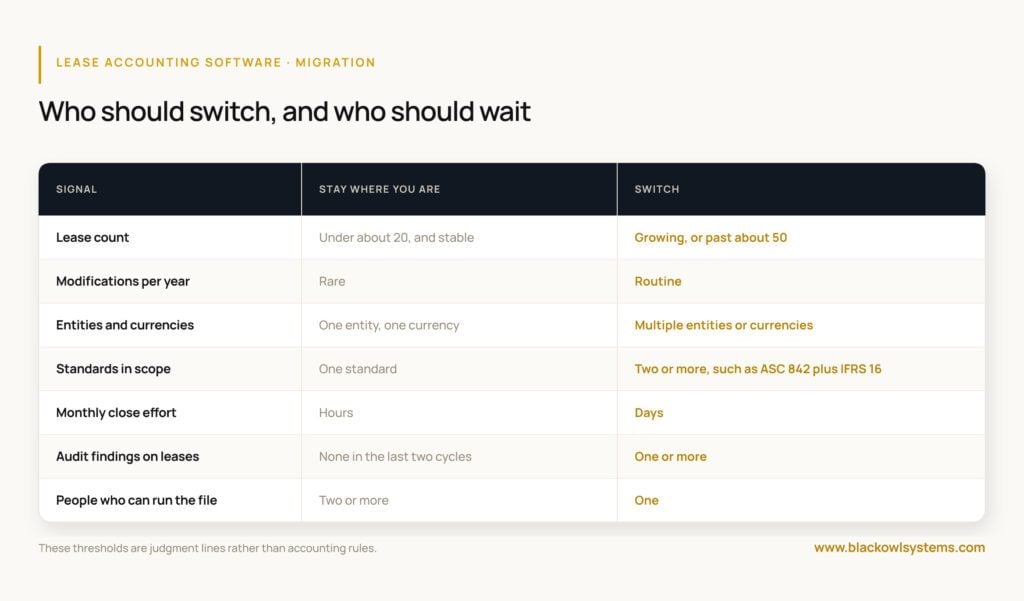
Switch lease accounting software when your portfolio has outgrown your control over it. Wait when the underlying problem is data quality, timing, or an unfinished adoption. Most vendors will never raise the second option with you.
When switching lease accounting software is the right call
Wait if you are still adopting ASC 842 or IFRS 16 for the first time. Running a new standard and a new system at once doubles your risk. Finish the adoption first, then close one clean year before you move.
A portfolio of under 20 stable leases with no modifications can wait. A spreadsheet still handles that volume, and the warning signs have not appeared. Timing counts too, so hold off if year-end close is eight weeks away.
Hold off if nobody can explain where your current lease balances came from. You have a lease abstraction problem, and new software will not solve it. Pay for the abstraction work first, and add the system after that.
When you should wait
Wait if you are still adopting ASC 842 or IFRS 16 for the first time. Running a new standard and a new system at once doubles your risk. Finish the adoption first, then close one clean year before you move.
A portfolio of under 20 stable leases with no modifications can wait. A spreadsheet still handles that volume, and the warning signs have not appeared. Timing counts too, so hold off if year-end close is eight weeks away.
Hold off if nobody can explain where your current lease balances came from. You have a lease abstraction problem, and new software will not solve it. Pay for the abstraction work first, and add the system after that.
When to switch: mid-year, at year-end, or during ASC 842 adoption
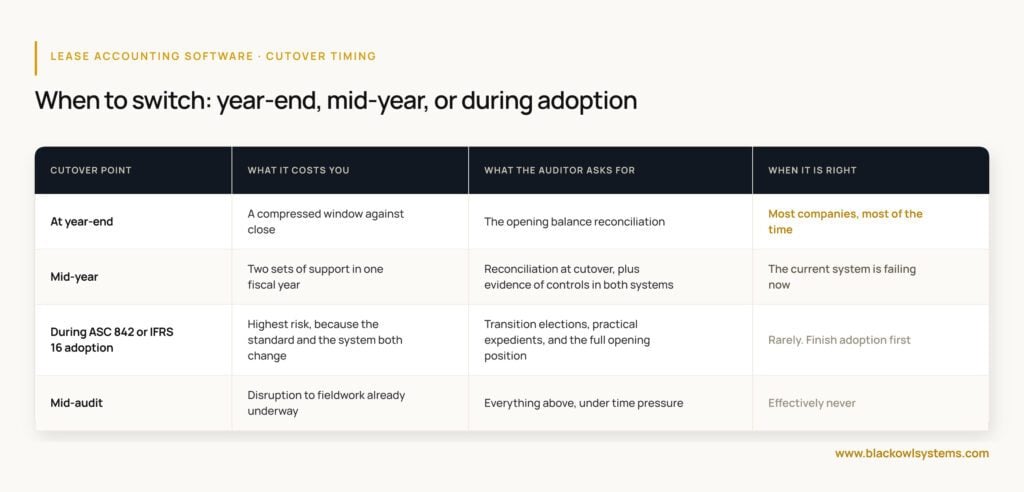
Year-end is the right cutover point for most companies. A year-end cutover means one system produced the whole fiscal year. Your auditor then needs one reconciliation instead of two sets of system-generated support.
What auditors ask for after a mid-year system change
Your accounting system forms part of the information system component of internal control. Auditors evaluate that component under PCAOB AS 2201 and AICPA SAS No. 130. A change in system is a change in that component.
Expect your audit team to make three specific requests. Auditors will want the cutover reconciliation tying old closing balances to new opening balances. They will want evidence that controls operated in each system during its period of use. They will also want the old system’s reports for the months before the cutover.
Keep read-only access to the retired system until your auditor signs that year. The PCAOB guide to internal control over financial reporting sets out what that evidence covers. Reviewing what auditors look for before fieldwork starts before you pick a date will save rework later.
How to migrate lease data from Excel, FinQuery, or a homegrown system
Migration and implementation are two different projects, and they carry separate budgets. Migration moves your lease data and balances into the new system. Implementation configures the system, the chart of accounts, and the process around it.
A vendor can implement fast and still migrate poorly. Scope and price the two projects on their own.
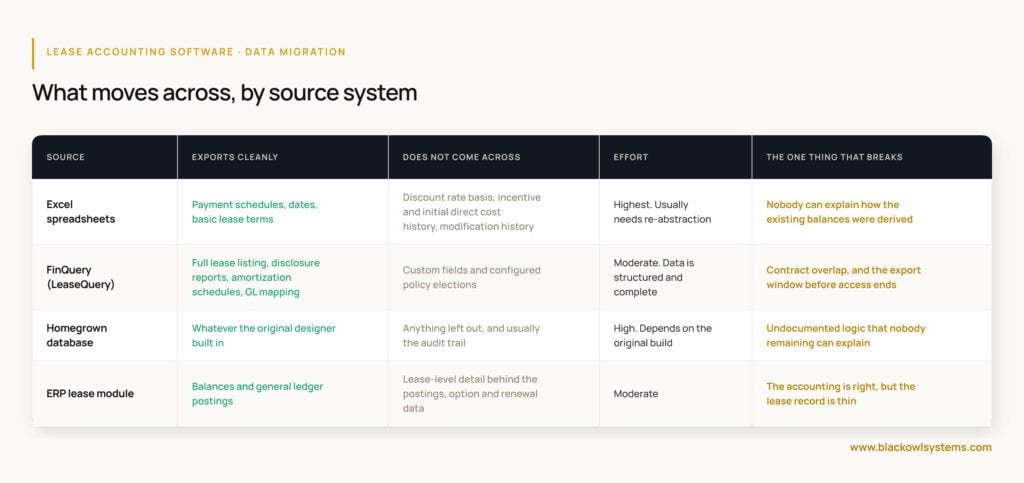
Every lease accounting software migration starts from a different source. What moves across cleanly depends on where your lease data lives now.
Migrating lease data from Excel spreadsheets
An Excel lease accounting software migration takes the longest of the four. A spreadsheet stores results, and it does not store your reasoning. Your workbook holds a payment schedule and a present value. It rarely records which discount rate you used or why you chose it.
Plan to re-abstract most leases from the signed contracts. Budget for that work before you sign with any vendor. Teams moving off a spreadsheet-run close underestimate this step every time.
Migrating lease data from FinQuery or LeaseQuery
Platform-to-platform migrations run cleaner than the other three source types. Your data is already abstracted and reconciled to the general ledger. Three simple rules protect that advantage during the move.
Export everything while your contract access is still live. Pull the full lease listing, including expired and terminated leases. Your comparative disclosures still need those older lease records.
Extract the disclosure reports and account balances too, since the reconciliation depends on them. A feature-level comparison against FinQuery shows which configured elections you must rebuild.
Migrating from a homegrown database or an ERP lease module
A homegrown system migrates only as well as its original build allows. If the original developer documented the logic, expect a clean export. If not, treat it like a spreadsheet and plan to re-abstract.
ERP lease modules present a different problem for the migration team. The general ledger postings are usually correct, but the lease-level detail behind them is thin. Renewal options, notice periods, and modification history often live somewhere else. Check your ERP integration options before assuming the lease data will move.
The lease data you need before you migrate
Gather these ten data groups before anyone starts your lease accounting software migration. Missing any one of them will stall the project or produce balances you cannot defend.
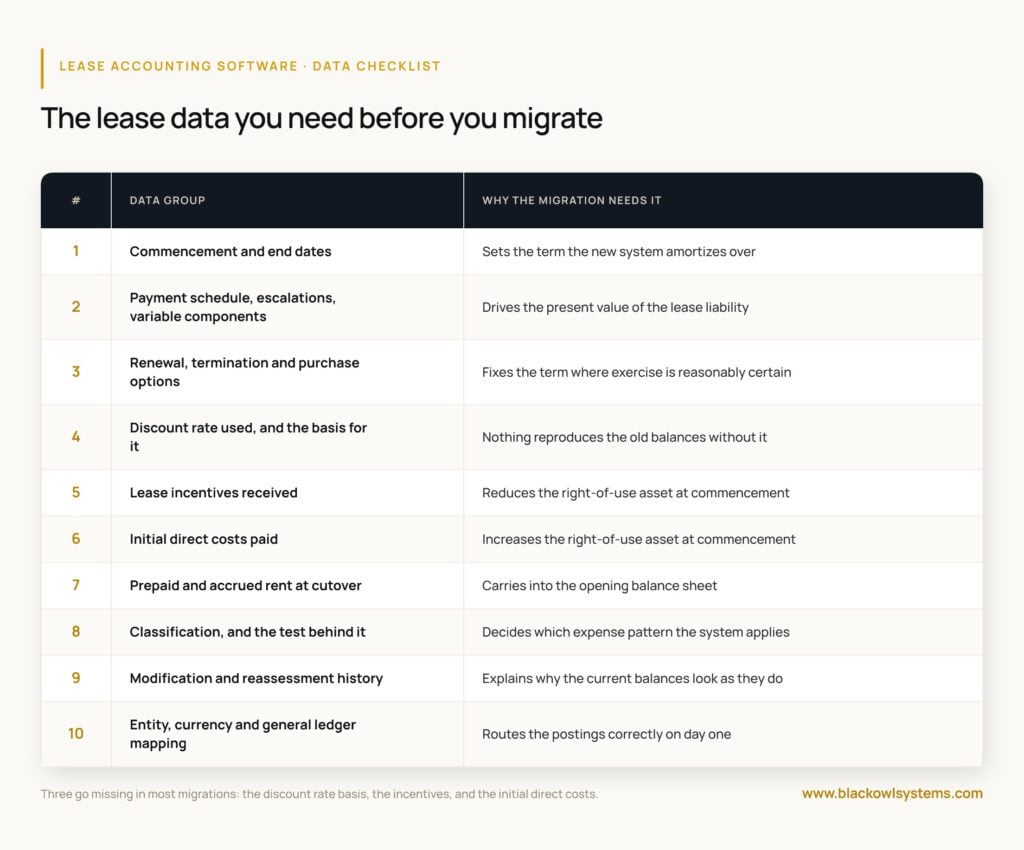
Our guide on what to gather before anyone touches a system breaks each group down further.
Three of them go missing in most lease migrations. They are the discount rate basis, the incentives, and the initial direct costs. The next section shows what that omission costs you.
How lease abstraction differs from data entry
Lease abstraction reads the signed contract and pulls out the terms that drive the accounting. Data entry keys in fields that someone else already extracted. Abstraction costs more and takes longer, and some portfolios need all of it.
You need abstraction whenever the current data does not trace back to a signed contract. You also need it when the person who built the original file has left.
Lease administration and lease accounting are two more terms worth separating here. Administration tracks critical dates, renewal options, and landlord obligations. Accounting produces the right-of-use asset and the matching lease liability, plus your disclosures. A migration that moves only administration data leaves your accounting incomplete.
A reconciliation and a parallel run solve two different problems. The parallel run operates both systems side by side and compares output each month. Your reconciliation proves that the old closing balances equal the new opening balances.
A reconciliation is usually enough. Where user acceptance testing against prior reported periods validates cleanly, most companies now go straight to go-live rather than running in parallel.
How to tie out the right-of-use asset and lease liability after cutover
A reconciliation and a parallel run solve two different problems. The parallel run operates both systems side by side and compares output each month. Your reconciliation proves that the old closing balances equal the new opening balances.
A reconciliation is usually enough. Where user acceptance testing against prior reported periods validates cleanly, most companies now go straight to go-live rather than running in parallel.
A worked opening balance reconciliation under ASC 842
Take an operating lease that commenced on January 1, 2023. It runs 60 months at $5,000 per month, paid in arrears. The incremental borrowing rate is 6.0% annually, or 0.5% monthly. Our lessee received a $30,000 lease incentive and paid $12,000 in initial direct costs.
ASU 2016-02 requires the lessee to increase the right-of-use asset by initial direct costs. The same guidance reduces that asset by any lease incentives received. The cutover happens on January 1, 2026, with 36 payments made and 24 remaining.
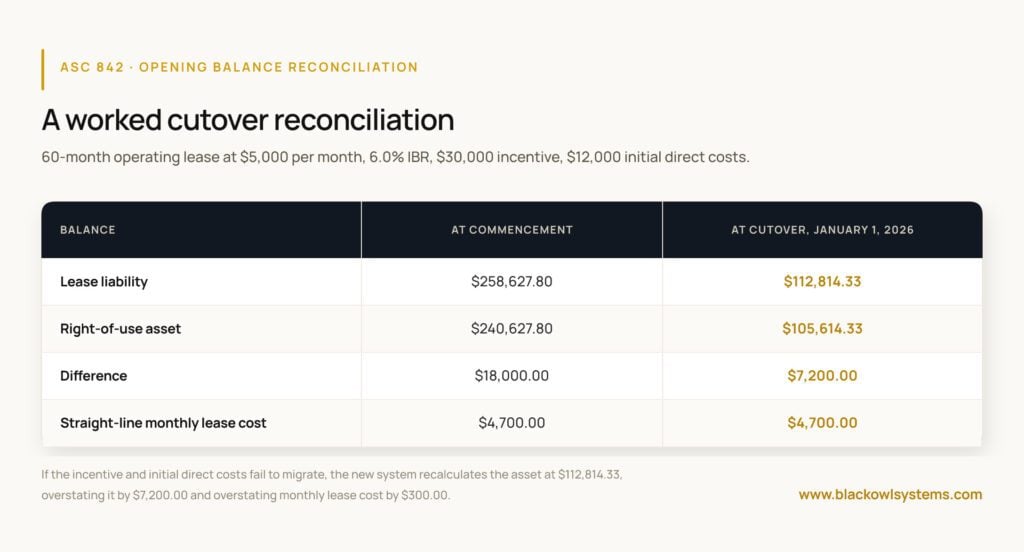
The two balances behave differently once a migration starts. A lease liability derives from the payment schedule and the discount rate alone. That makes it the balance most likely to survive the move intact. Your right-of-use asset carries three extra inputs, and those inputs often fail to arrive.
Suppose the $30,000 incentive and $12,000 of initial direct costs never reach the new system. The platform then recalculates the right-of-use asset at $112,814.33, which equals the lease liability. That overstates the asset by $7,200.00 on this single lease.
Straight-line lease cost then computes at $5,000 instead of $4,700, overstating expense by $300 monthly. The $7,200 equals the $18,000 net adjustment spread across the 24 remaining months of the term.
Run this test on a sample of leases before you accept the migration. Compare the monthly schedule each system builds for the same lease. If the asset that appears on the balance sheet differs, your incentives or initial direct costs did not transfer.
What happens to historical journal entries
Historical journal entries stay in your general ledger, and nobody re-posts them. The new system takes over from the cutover date forward. Do not try to recreate prior-period history inside the new platform.
Keep the retired system’s reports as audit support for the periods it ran. Your trial balance already carries every posted amount from those periods.
What switching lease accounting software costs, and how long it takes
Five separate costs make up switching lease accounting software, and most budgets capture only two of them.
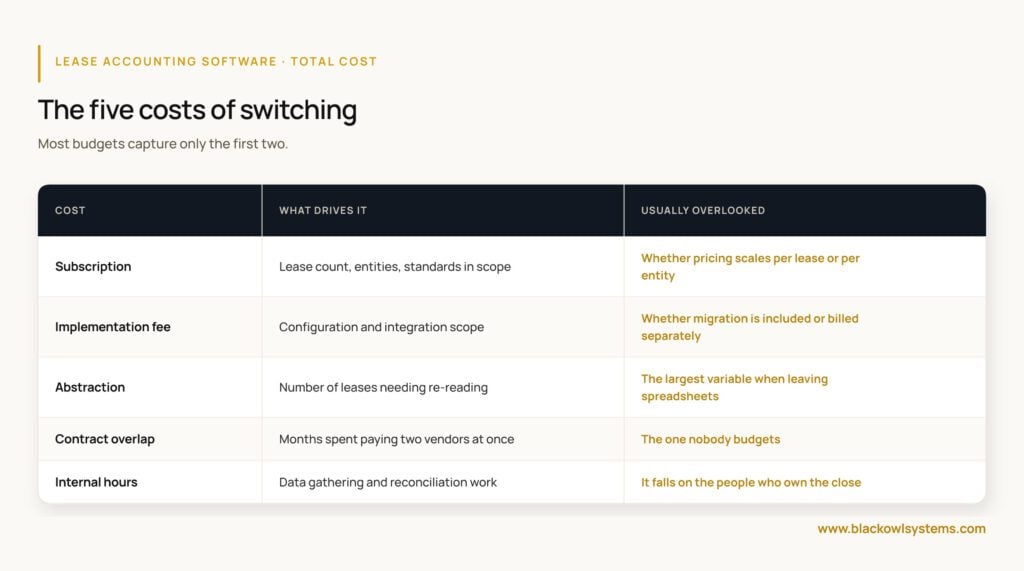
Duration depends on lease count and data quality, and honest vendors will say so. The controlling variable is whether your source data exports or needs re-abstraction. A clean platform-to-platform export moves far faster than a spreadsheet rebuild. Treat any fixed timeline quoted before a data review as a sales number.
Contract overlap is the cost nobody budgets
Start your evaluation several months before your current contract renews. Signing after renewal means paying two vendors at once for a full term. That overlap often costs more than the implementation fee itself.
Onboarding speed depends on how much of the work the vendor’s team absorbs. Ask what each vendor includes before you compare prices. Look for abstraction, reconciliation support, and a named implementation contact. For the rollout itself, follow a ten-step plan for running the project.
Questions to ask a vendor before you sign
Ask these eight questions before signing any multi-year lease accounting software contract. Each one has a plain answer, and a vague reply tells you something on its own.
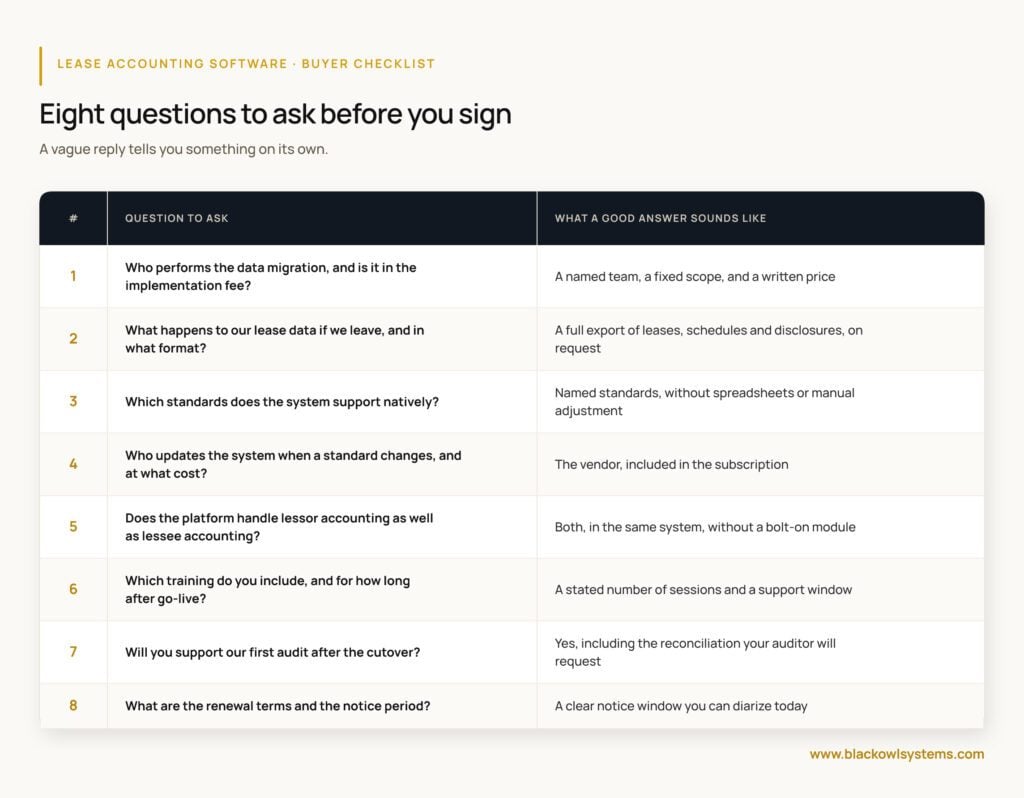
Buyers underrate question four at signing, and it costs them later. The FASB still refines Topic 842 through its post-implementation review. Its ongoing leases project may change your requirements again. Compliance updates should arrive as part of your subscription.
Standards coverage: ASC 842, IFRS 16, ASPE 3065, and GASB 87
Check standards coverage before anything else on the shortlist. Confirm which of the four your vendor supports without manual adjustment.
US companies need ASC 842, and international reporters need IFRS 16. Canadian private enterprises need ASPE Section 3065, which CPA Canada covers in its ASPE resource guide. Government entities in the United States need GASB Statement No. 87.
Most vendors cover ASC 842 and IFRS 16 without any trouble. Fewer cover how ASPE 3065 differs, and fewer still handle lessor-side treatment of the same transaction.
Making the switch with Black Owl
Black Owl Systems handles the parts of switching lease accounting software that stall most teams.
- Native coverage for ASC 842, IFRS 16, and ASPE 3065 in one system.
- Lessee and lessor accounting together, without a separate module or a workaround.
- Migration from Excel, FinQuery, or a homegrown database, including the reconciliation.
See how software built for both lessee and lessor accounting handles your portfolio. You can also talk to our team about your cutover date and pricing.
Frequently Asked Questions
Can you switch lease accounting software mid-year?
Yes, you can switch lease accounting software mid-year without restating anything. Nothing in ASC 842 or IFRS 16 prevents a mid-year cutover date. Reconcile the old system’s closing balances to the new system’s opening balances at that date. Expect your auditor to request evidence that controls operated in each system.
Do you have to restate prior periods when you switch systems?
No, you do not restate prior periods when you switch lease accounting systems. Changing software does not change your accounting policy or your measurement basis. Your right-of-use asset and lease liability carry forward at their existing balances. The new system begins producing journal entries from the cutover date forward.
What is the best lease accounting software?
The best lease accounting software covers your standards natively and imports your existing data. Judge each vendor on standards coverage, migration support, lessor capability, and compliance updates. Ask who absorbs the cost when a standard changes during your contract term. Our guide to the questions buyers ask about these systems works through each criterion.
How long should you keep access to the old system?
Keep read-only access to the old system until your auditor signs the final year. That period usually runs 9 to 18 months after cutover, depending on your year end. Negotiate the access term before you cancel, because restoring access costs far more. Export your full lease listing and disclosure reports regardless of what you negotiate.
What is the 90% rule in leasing?
The 90% rule was the ASC 840 bright line for classifying a capital lease. A lease qualified when the present value of minimum payments reached 90% of fair value.
ASC 842 replaced those bright lines with five classification criteria. Those criteria use a substantially all threshold instead of a percentage. See how the classification tests replaced the old bright lines for the current tests.
Why was IAS 17 replaced?
The IASB replaced IAS 17 with IFRS 16 because operating leases stayed off the balance sheet. Lessees disclosed large lease commitments in the notes while reporting no matching asset. IFRS 16 now requires a right-of-use asset and a lease liability for nearly all leases. Read more on the international treatment and how it differs from the US standard.

Greg Kautz
Greg Kautz, CPA, CMA is a seasoned management consultant and professional accountant with over 40 years of experience in the consulting and energy sectors. At Black Owl Systems, Greg brings deep expertise in ERP systems, corporate finance, strategic planning, and technology integration.
