
Lease Accounting Software for Private Companies: Black Owl vs FinQuery
Private companies generally begin looking for lease accounting software later than public companies. They also tend to enter the market for different reasons. The compliance deadline is already behind them, the lease portfolio has expanded, and the spreadsheet is now producing figures that are becoming difficult to explain or defend.
Private-company buyers often consider a distinct shortlist of platforms. This comparison examines Black Owl Systems and FinQuery, while also considering when neither platform may be necessary.
Does a private company need lease accounting software?
A private company needs lease accounting software when its spreadsheet can no longer manage the portfolio reliably. For many organizations, that point arrives somewhere between 20 and 50 leases. A carefully maintained spreadsheet can still produce defensible results below that range, although the number of leases matters less than the frequency and complexity of changes to their terms.
Buyers also tend to combine two related but different requirements. Lease accounting calculates the right-of-use asset, lease liability, journal entries, and disclosures. Lease administration manages critical dates, renewal options, landlord responsibilities, and other operational obligations.
Many private companies primarily need the accounting capability while writing requirements that describe an administration platform. That can distort the shortlist from the beginning. Before defining the requirements, review what spreadsheets begin to handle poorly as a lease portfolio grows.
When a private company outgrows spreadsheets
Six indicators can suggest that a spreadsheet is no longer sufficient. No single one settles the decision, but the appearance of three at the same time will usually make the case for software much stronger.
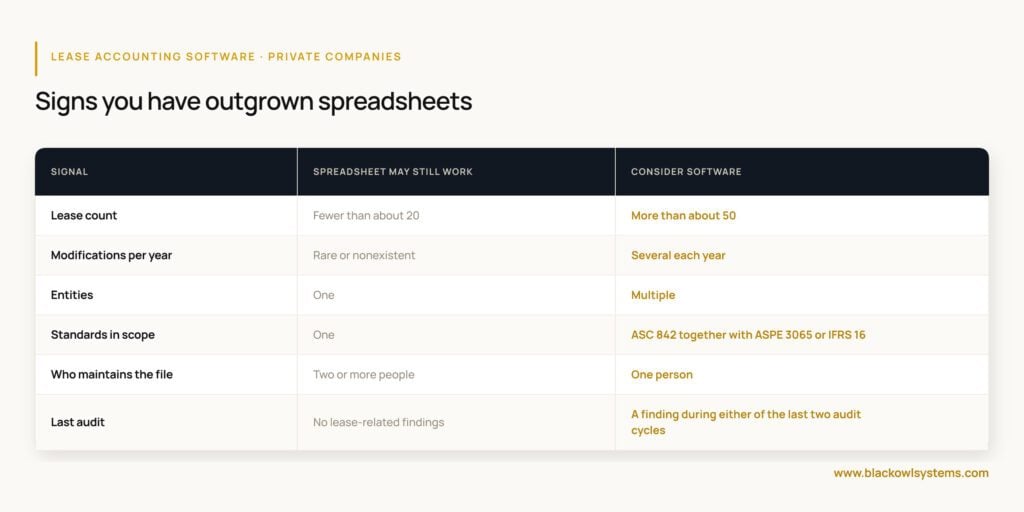
Private-company buyers often evaluate the cost on a per-lease basis. That approach reflects how many vendors in this segment structure their quotes, with pricing affected by lease count and the number of entities. A portfolio of 30 leases is a different purchase from one containing 300, and the cost per lease provides a useful basis for comparing the two.
The annual software cost should also be weighed against the time the controller spends rebuilding, checking, and reconciling schedules during each close. Smaller portfolios can review how lease accounting works for smaller businesses. In practice, these warning signs often emerge together within the same quarter.
What ASC 842 asks of a private company
ASC 842 became effective for private companies for fiscal years beginning after December 15, 2021. The FASB established the deadline according to public business entity status rather than company size. A privately held company with 400 employees therefore received the same later deadline as one with only 12.
Three dates are frequently confused during adoption. The effective date establishes when the standard begins applying to the organization. The adoption date is the opening day of the earliest period presented in its financial statements.
Opening balances are measured at the transition date. Our guide to the ASC 842 deadline for private companies explains the difference between all three dates.
Private companies also receive an accounting relief that is not available to public companies. The FASB allows a private company to elect a risk-free rate by class of underlying asset. This can reduce the work required to determine discount rates, although it also increases the resulting lease liability and should therefore be selected carefully.
During fieldwork, auditors will typically request three items: a complete population of leases, support for every discount-rate determination, and documentation supporting the classification of each lease.
The lease accounting system also forms part of internal control over financial reporting. Auditors therefore assess it under PCAOB AS 2201.
Before evaluating vendors, work through the information auditors expect to see before fieldwork begins. Those requirements should form the foundation of the software-selection process.
Black Owl vs FinQuery for a private company
FinQuery and LeaseQuery now refer to the same company. LeaseQuery was retained as the name of the lease accounting product after the company rebranded as FinQuery and broadened its platform. Review directories continue to index both names, which is why buyers often encounter separate results during their research.
FinQuery competes within a clearly established group of lease accounting platforms. Directory listings identify six closely related alternatives: Visual Lease, NetLease by Netgain, LeaseAccelerator, Nakisa, EZLease, and Leasecake.
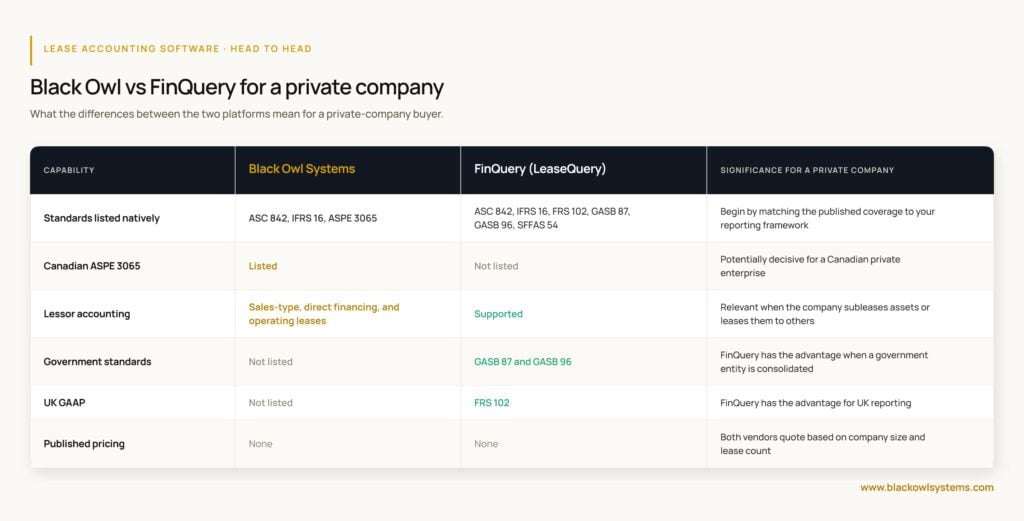
Black Owl participates in the same market. Our broader feature-by-feature comparison of Black Owl and FinQuery examines the general differences between the two. The table below focuses specifically on what those differences mean for a private company.
Where Black Owl fits a private company
Black Owl is aimed at private companies that want to automate lease accounting without taking on an enterprise-scale implementation. The platform supports ASPE 3065 measurement, classification, and reporting, in addition to ASC 842 and IFRS 16.
Lessor accounting is included in the same system rather than sold as a separate module. Black Owl’s own materials state that the software “isn’t just for lessees,” with lessor coverage extending to sales-type, direct-financing, and operating leases.
A private company that subleases office space or other assets can therefore manage both sides of the arrangement within one platform. That combination is relatively uncommon in this part of the market. Black Owl’s explanation of lessor accounting shows where the capability applies.
Where FinQuery fits a private company
FinQuery publishes support for a wider range of reporting frameworks. Its product page states that LeaseQuery “fully handles” ASC 842, IFRS 16, FRS 102, GASB 87, and SFFAS 54. GASB 96 is also included in the standards listed on the same page.
An independent comparison published by Netgain reaches a similar conclusion about FinQuery’s standards coverage. It also identifies general-ledger flexibility, dual-standard reporting, and bulk lease uploads as strengths, while noting integrations with most major ERP platforms. That wider scope can require more implementation work, but it also provides genuine breadth.
Where FinQuery is the better choice for a private company
There are four clear situations in which FinQuery may be the more suitable purchase for a private company. A useful comparison should identify those cases directly.
FinQuery deserves preference when a private company expects to become a public business entity within the next several years. It is also the stronger option when the organization consolidates an entity reporting under GASB 87 or GASB 96.
The same applies to companies that require UK reporting under FRS 102 or federal reporting under SFFAS 54. FinQuery’s connector coverage can also make it the better fit when the organization operates an unusual ERP environment.
Standards coverage: ASC 842, IFRS 16, ASPE 3065, and GASB 87
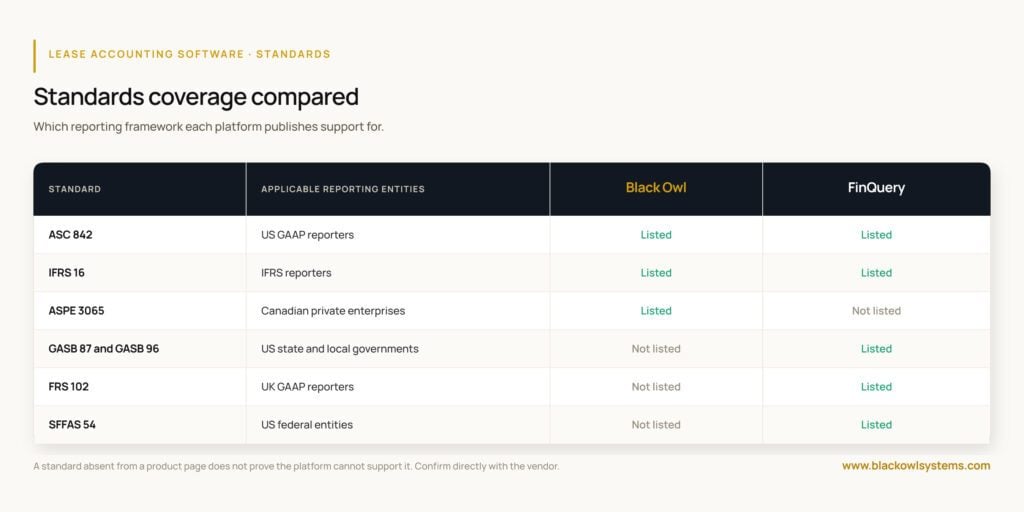
The ASPE 3065 row requires particular attention. ASC 842 applies under US GAAP, while ASPE 3065 is the lease accounting standard used by Canadian private enterprises.
A Canadian private company reporting under ASPE does not apply ASC 842. It continues to classify leases as either capital or operating leases. Software designed exclusively around ASC 842 will not produce that treatment.
FinQuery does not include ASPE 3065 in its published list of supported standards. The absence of a standard from a product page does not prove that the platform cannot support it, however, so buyers should confirm the capability directly with the vendor before reaching a decision.
For many Canadian private enterprises, that single requirement can determine which vendors remain on the shortlist. CPA Canada’s ASPE summary resource guide outlines the broader framework, while Black Owl’s guide explains how ASPE 3065 differs.
What lease accounting software costs a private company
Lease accounting vendors serving private companies generally price by custom quote rather than a public list price. Neither Black Owl nor FinQuery publishes rates on its website. Netgain’s comparison likewise states that both companies determine pricing according to factors such as company size and use case.
The vendors’ own product sites are consistent with that finding. Figures appearing in software directories should therefore be treated as unverified unless the vendor confirms what they include.
Thinking in dollars per lease
Ask each vendor to divide the annual cost by the number of leases in the portfolio. That figure can be compared across platforms, whereas a headline subscription price provides little context by itself.
Most quotes in this market contain four main cost components.
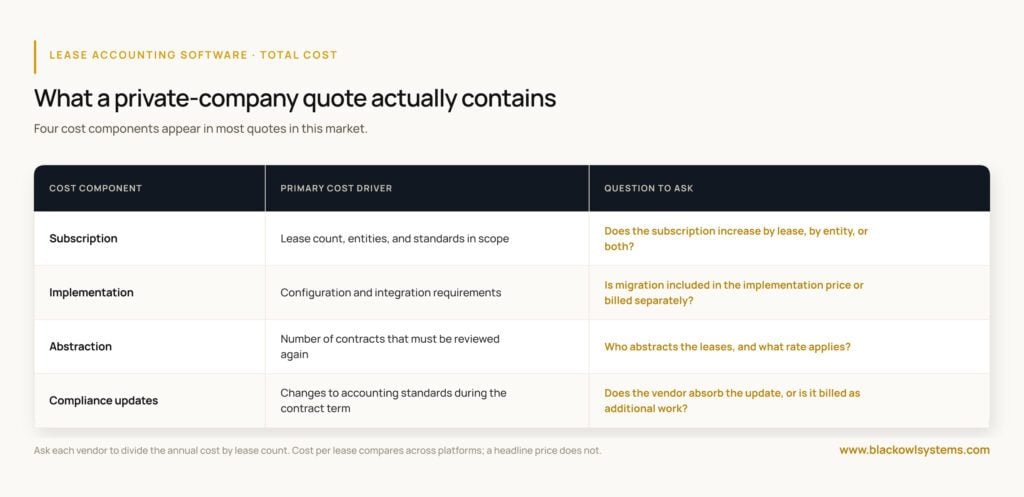
The final category is particularly important for private companies. Some vendors treat a change to an accounting standard as a separate change order, while others include it within the subscription. Compare the complete cost with the annual cost of operating the wrong lease accounting system.
Switching from FinQuery, and what to ask a vendor
A successful move from one lease accounting platform to another depends primarily on the condition and completeness of the underlying data. Existing right-of-use asset and lease liability balances transfer into the new platform. The cutover reconciliation is what demonstrates that the new system has reproduced them correctly.
Our ten-step migration plan explains the mechanics of that process.
Questions a private company should ask before signing
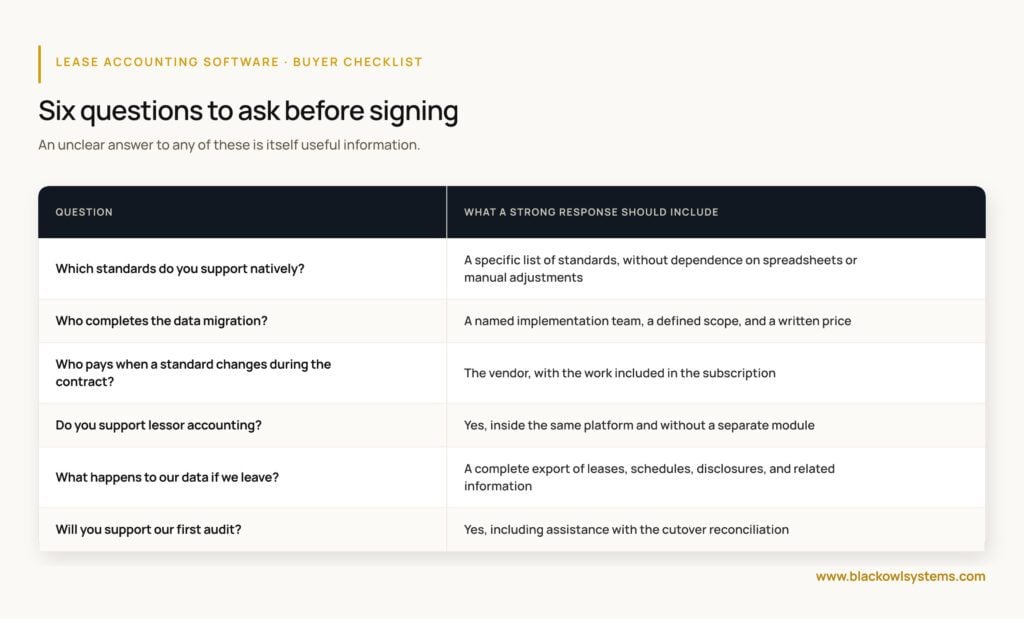
Before the first demonstration, review the criteria that distinguish lease accounting platforms. An unclear answer to any of these six questions is itself useful information.
The verdict for a private company
Black Owl is likely to be the closer fit for a private company managing between 20 and 200 leases. That assessment applies to organizations reporting under either ASC 842 or ASPE 3065. The platform lists ASC 842, IFRS 16, and ASPE 3065 together, while also supporting lessee and lessor accounting within the same system.
Canadian private enterprises face the most direct distinction. Native ASPE 3065 support reduces the number of viable vendors considerably.
FinQuery becomes the stronger option when government, federal, or UK reporting enters the organization’s scope. A planned public listing can also favour FinQuery. Because both vendors quote according to company size and portfolio requirements, buyers should obtain the annual cost per lease from each before comparing the proposals.
Choosing between them
Black Owl Systems provides lease accounting software for private companies. Its typical small customer is a finance team of one or two people seeking automation without an enterprise-scale rollout.
- Native support for ASC 842, IFRS 16, and ASPE 3065, including the requirements of Canadian private enterprises.
- Lessee and lessor accounting within the same platform, covering sales-type, direct-financing, and operating leases.
- Implementation and migration support designed around the needs of a small finance team.
See how a platform built for both lessee and lessor accounting can manage your portfolio. Alternatively, speak with the Black Owl team about your reporting standards and lease count.
Frequently Asked Questions
Do private companies have to follow ASC 842?
Yes. ASC 842 applies to private companies for fiscal years beginning after 15 December 2021. The FASB determines the deadline according to public business entity status rather than company size.
A private company may also elect to use a risk-free discount rate by class of underlying asset. The election is optional, and the company should document the reasoning behind its decision.
How much does lease accounting software cost for a private company?
Lease accounting platforms in this market are generally priced through individual quotes, and neither Black Owl nor FinQuery publishes standard rates. The final price is influenced by lease count, entity count, and the reporting standards that must be supported.
Ask each vendor to calculate the annual price per lease. That number is easier to compare across platforms. Our lease accounting software guide addresses the other questions buyers commonly raise.
Who are LeaseQuery’s main competitors?
LeaseQuery, now offered under the FinQuery brand, competes directly with Visual Lease and NetLease by Netgain. Other alternatives include LeaseAccelerator, Nakisa, EZLease, Leasecake, and Black Owl Systems.
G2 and Gartner directory listings identify much of the same group. The right option depends on the company’s reporting framework, lease count, and need for lessor accounting.
Does FinQuery support ASPE 3065?
FinQuery does not list ASPE 3065 among the accounting standards published on its product page. Its stated coverage includes ASC 842, IFRS 16, FRS 102, GASB 87, GASB 96, and SFFAS 54.
An independent Netgain comparison identifies the same six standards. The absence of ASPE 3065 from published materials does not establish that the platform lacks the capability, so buyers should verify the point directly with FinQuery.
What software do private equity firms use?
Private equity firms commonly manage lease accounting at the portfolio-company level and then consolidate the resulting information upward. Sponsors usually prioritize consistency across holdings and audit readiness ahead of an eventual exit.
For that reason, implementation speed can matter more than an extensive feature set. The preference often moves toward a platform that each portfolio company can adopt without a long or highly technical rollout. Our guide to lease accounting for private equity portfolios explains the reporting considerations.
Can a private company stay in Excel?
Yes. Excel can remain workable for a private company with a small and stable lease portfolio. A well-designed workbook may continue producing defensible figures when the company has fewer than approximately 20 leases and rarely modifies them.
That position becomes harder to sustain once modifications are common or the company adds another reporting entity. The strongest warning sign is often that one person has become the sole owner of the entire workbook and process.
How long does implementation take for each?
Black Owl quotes an implementation of about 4 to 8 weeks, led by a CPA team. Visual Lease does not publish an implementation timeline, and uses a professional services model. So compare them by asking each vendor for a firm date. Black Owl also provides ready-to-use templates for loading your existing leases.

Greg Kautz
Greg Kautz, CPA, CMA is a seasoned management consultant and professional accountant with over 40 years of experience in the consulting and energy sectors. At Black Owl Systems, Greg brings deep expertise in ERP systems, corporate finance, strategic planning, and technology integration.
