
The 5 Capabilities That Separate Enterprise-Grade Lease Accounting Platforms (And How to Test for Each One)
Most lease accounting platforms look identical in a demo. Clean dashboards, an amortization schedule, a compliance checkmark for ASC 842 and IFRS 16. The differences that matter (i.e., the ones that determine whether your close runs smoothly or your team is back in spreadsheets by Q2) only show up when you know exactly what to ask.
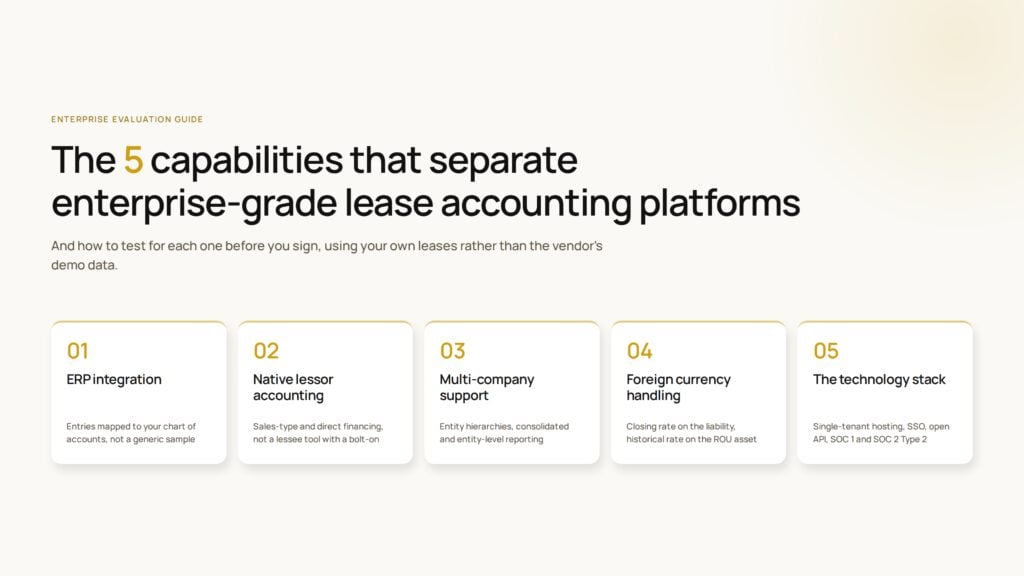
After working with finance teams managing everything from a few hundred leases to tens of thousands, we’ve found that five capabilities consistently separate enterprise-grade platforms from tools that were built for simpler portfolios: ERP integration, true lessee and lessor accounting, multi-company support, foreign currency handling, and the technology stack sitting underneath it all.
Here’s a walkthrough of each: what it should look like when done right, and how to determine whether a platform actually has it before you sign.
1. ERP Integration That Fits Your Close, Not the Vendor's Roadmap
Lease accounting doesn’t happen in isolation. Every journal entry your lease platform generates has to land in your general ledger, i.e., mapped to your chart of accounts, your entities, your cost centers, and your posting calendar. A platform that can’t integrate cleanly with your ERP turns every month-end into a manual export-reformat-import exercise, which is exactly the error-prone process you bought software to eliminate.
Enterprise-grade integration means more than a logo wall. It means the platform can produce journal entries in the structure your ERP expects, handle multiple ERPs if your organization runs more than one (common after acquisitions), and support both automated feeds and controlled file-based transfers depending on your IT environment.
In practice, “ERP integration” is really integration with a specific system, i.e., SAP (S/4HANA and ECC), Oracle (Fusion and E-Business Suite), Oracle NetSuite, Microsoft Dynamics 365, Workday, and Sage are the environments enterprise finance teams ask about most.
The connection can take three forms:
- A native API connector (real-time, bidirectional)
- A middleware / iPaaS layer (e.g., an integration platform sitting between systems),
- A flat-file transfer (CSV or IDoc uploads on a schedule).
Ask which one you’re actually getting. For a deeper walkthrough, see our guide on how to unify lease data with your ERP.
How to determine if a platform has it:
- Ask to see a journal entry export mapped to your chart of accounts, not a generic sample.
- Ask which ERPs they support today and specifically how: native API connector, flat-file, or middleware. “We integrate with everything” usually means flat-file for everything.
- Ask what happens when your COA changes. Can mappings be updated by your team, or does it require a vendor services ticket?
- If you run multiple ERPs across entities, ask them to demonstrate entity-level output formatting, i.e., one export shaped for each system.
2. Native Lessor Accounting, Not a Lessee Tool with a Bolt-On
Most platforms in this market were built lessee-first, because that’s where the ASC 842 and IFRS 16 adoption wave created demand. Lessor accounting (i.e., sales-type leases, direct financing leases, operating leases from the lessor side, net investment in lease calculations, and lessor disclosures) was either bolted on later or never built at all.
If your organization sits on both sides of lease transactions (equipment dealers, energy, transportation, real estate, and intercompany leasing arrangements all commonly do), a lessee-only tool means running your lessor book in Excel. That splits your lease population across two systems, doubles your reconciliation work, and leaves the more judgment-heavy side of your portfolio without an audit trail.
Enterprise-grade platforms handle both lessee and lessor accounting in one system, with one data model, so a single lease (including subleases, where you’re lessee and lessor on related contracts) lives in one place.
The technical dividing line is the net investment in the lease, i.e., the lessor-side figure that combines the lease receivable and any unguaranteed residual, with the selling profit or loss recognized at commencement for a sales-type lease.
Under ASC 842, lessor classification (sales-type, direct financing, or operating) follows the same five criteria used for lessee finance-lease classification; under IFRS 16, lessors still apply the finance-versus-operating split that lessees no longer use.
If you want the straightforward version of both sides, see lessee vs. lessor: key differences, our note on whether ASC 842 applies to lessors, and the guide to sublease accounting under ASC 842.
How to determine if a platform has it:
- Ask them to walk through a sales-type lease from classification to derecognition, including the selling profit calculation and the net investment rollforward. If the demo pivots back to lessee screens, you have your answer.
- Ask for the lessor disclosure reports out of the box, i.e., maturity analysis of lease receivables, income statement disclosures by lease type.
- Ask how a sublease is handled: does the head lease and sublease link, or are they two disconnected records?
- Ask how long lessor functionality has been in production and for a reference customer using it.
3. Multi-Company Support Built for Real Corporate Structures
Enterprise lease portfolios don’t belong to one legal entity.
They’re spread across subsidiaries, divisions, joint ventures, and newly acquired companies, each with its own GL, its own reporting calendar, sometimes its own accounting standard, and its own set of people who should only see their own leases.
A platform built for a single-entity world forces workarounds: separate instances per entity (with separate logins and no consolidated view), or one flat database where entity-level reporting means filtering a spreadsheet export. Neither survives an audit gracefully, and neither scales through your next acquisition.
Enterprise-grade multi-company support means entity hierarchies that mirror your org structure, journal entries and disclosure reports at both the entity and consolidated level, role-based access so a divisional controller sees only their portfolio, and the ability to run different standards for different entities. For example, IFRS 16 at a foreign subsidiary rolling up to an ASC 842 parent, with both sets of entries generated from the same lease record.
This is where multi-entity lease accounting meets consolidation, i.e., intercompany leases have to eliminate cleanly at the group level, and a Canadian subsidiary on ASPE 3065, a European one on IFRS 16, and a US parent on ASC 842 should all report from one lease record without three separate systems.
For private-equity-backed groups adding portfolio companies every year, the ability to onboard an acquired entity mid-year is the difference between a scalable process and a rebuild; we cover that in lease accounting for private equity and how to build a scalable lease accounting process.
How to determine if a platform has it:
- Ask them to model a piece of your actual org chart (i.e., parent, two subsidiaries, one on a different standard) and produce entity-level and consolidated disclosures from it.
- Ask how intercompany leases are handled. Can one contract generate the lessee entries in one entity and the lessor entries in another?
- Ask about access controls: can you restrict a user to one entity’s leases without a separate license or instance?
- Ask what onboarding an acquired company’s lease portfolio looks like, i.e., mid-year, with a different fiscal calendar.
4. Foreign Currency Handling That Matches the Standards, Not Approximations
FX is where lease accounting software most often quietly gets it wrong. Under both ASC 842 and IFRS 16 (via IAS 21), the lease liability is a monetary item, i.e., remeasured at the closing rate each reporting date, with gains and losses through the income statement.
The right-of-use asset is nonmonetary, i.e., it stays at the historical rate from commencement. Interest accretion is typically translated at average rates.
That means a single foreign-currency lease produces three different exchange rate treatments every single month. A platform that translates everything at one rate (or worse, leaves FX remeasurement as a manual topside entry) isn’t approximating the answer. It’s producing the wrong one, and your auditors will find it.
Enterprise-grade FX support means the platform stores the lease in its contractual currency, remeasures the liability at closing rates automatically, holds the ROU asset at historical rates, calculates the FX gain/loss entry itself, and reports in both transactional and functional currency, i.e., every period, without manual aggregation.
At the group level, this feeds the cumulative translation adjustment (CTA), i.e., the equity line that captures the effect of translating a foreign subsidiary’s results into the parent’s presentation currency.
The governing standard is IAS 21, The Effects of Changes in Foreign Exchange Rates (IFRS Foundation); the monetary-versus-nonmonetary split it prescribes is exactly why the liability and the ROU asset move at different rates.
For a worked, step-by-step treatment, see our guide on managing FX and currency risk in global leases.
How to determine if a platform has it:
- Give them a real scenario: a USD-functional entity with a EUR-denominated lease. Ask to see the monthly entries, including the FX remeasurement gain/loss on the liability.
- Ask which rate is applied to the liability, the ROU asset, and interest expense and confirm they’re different. If the answer is one blended rate, the math is wrong.
- Ask where exchange rates come from: automated rate feeds, manual entry, or import from your ERP’s rate tables.
- Ask to see reporting in both the lease currency and the functional currency for the same lease, side by side.
5. A Modern Technology Stack Underneath the Accounting
The accounting engine gets all the attention in a software evaluation, but the technology underneath it determines whether the platform is still serving you well in year three.
Several of the older tools in this market run on architecture designed fifteen or twenty years ago, and it shows up in ways that matter to a controller: slow reports on large portfolios, clumsy security models, and data you can’t get out without a services engagement.
Four things are worth checking under the hood.
Cloud architecture (single-tenant is best)
Most SaaS platforms are multi-tenant, meaning your lease data sits in a shared database alongside every other customer’s.
Single-tenant hosting gives your organization its own isolated environment: your data is physically separated, another customer’s month-end crunch can’t slow your reports down, and questions from your security team about data residency and isolation get much easier answers. (Modern single-tenant platforms typically run on AWS or Azure, which also makes data-residency questions – i.e., US, EU, or Canadian hosting – straightforward to answer.)
Authentication and security
At enterprise scale, user access has to run through your existing identity infrastructure.
That means single sign-on through SAML or your identity provider, multi-factor authentication, role-based access controls granular enough to separate a divisional user from a group controller, and encryption of data both in transit and at rest.
A platform that manages users through standalone passwords was not built for your environment. (In concrete terms: SAML 2.0 or OpenID Connect SSO, MFA, RBAC, and AES-256 encryption at rest with TLS 1.2+ in transit.)
An open API
Your lease data shouldn’t be trapped inside the vendor’s report writer. An open, documented API lets you pull lease balances into your BI tools, feed FP&A models directly, and push data in from procurement or contract management systems.
It’s also your insurance policy, i.e., if you ever leave, your data comes with you. (This is the same integration surface that connects lease data to treasury and FP&A workflows.)
Both SOC 1 and SOC 2
These are different reports covering different things, and you want both.
SOC 1 covers controls over financial reporting, i.e., directly relevant because your auditors will rely on it when they assess the numbers your lease platform produces.
SOC 2 covers security, availability, and processing integrity, i.e., what your IT and risk teams care about. Type 2 reports, which test controls over a period of months rather than a single point in time, are the meaningful ones. (Both are AICPA System and Organization Controls reports; see the AICPA SOC overview for what each attestation covers.)
How to determine if a platform has it:
- Ask directly: single-tenant or multi-tenant? If multi-tenant, ask how your data is isolated and what happens to report performance at quarter-end when every customer is closing at once.
- Ask for current SOC 1 Type 2 and SOC 2 Type 2 reports under NDA. A vendor with only one of the two, or only Type 1, has gaps. Check the report dates, i.e., a three-year-old report tells you nothing.
- Ask to see SSO configured live, and ask which identity providers they support out of the box.
- Ask for the API documentation before you sign, not after. If it isn’t published or the vendor hesitates, the “API” may be a services team running exports for you.
How Enterprise Platforms Differ from Mid-Market Lease Tools
Lessee and lessor accounting in one platform (Black Owl)
Every capability above is table stakes for a genuinely enterprise platform and a genuine gap in most mid-market tools. Standards breadth is the fastest tell: a mid-market tool may cover ASC 842 and IFRS 16 and stop there, while enterprise portfolios also touch ASPE 3065 (Canada), GASB 87 (US government), and FRS 102 (UK).
Vendor architecture is the second tell, i.e., several well-known platforms, including FinQuery (formerly LeaseQuery), Visual Lease, Nakisa, Trullion, LeaseAccelerator, and CoStar Real Estate Manager, were each designed around a particular buyer, so their depth in lessor accounting, multi-entity consolidation, and FX varies widely.
We break the field down side by side in our companion guide, the best enterprise lease accounting software in 2026, and in our full best lease accounting software in 2026 comparison. If you’re mid-evaluation, how to choose the right accounting software for enterprise walks through the selection criteria in order.
The Pattern: Capabilities Are Proven in Scenarios, Not Feature Lists
Notice what every test above has in common, i.e., none of them can be answered with a checkbox on an RFP. Feature matrices tell you what a vendor claims.
Scenario walkthroughs tell you what the platform actually does, because complex lessee-lessor structures, entity hierarchies, and FX remeasurement can’t be faked live with your data on the screen.
So before your next evaluation, pick your three hardest leases (the intercompany sublease, the foreign-currency equipment lease, the sales-type lease with a mid-term modification) and ask every vendor to walk through them end to end.
The platforms built for enterprise complexity will welcome it. The ones that weren’t will reschedule.
Want to see how Black Owl handles your most complex leases? Book a demo and bring your hardest three.
Frequently Asked Questions
What is enterprise lease accounting software?
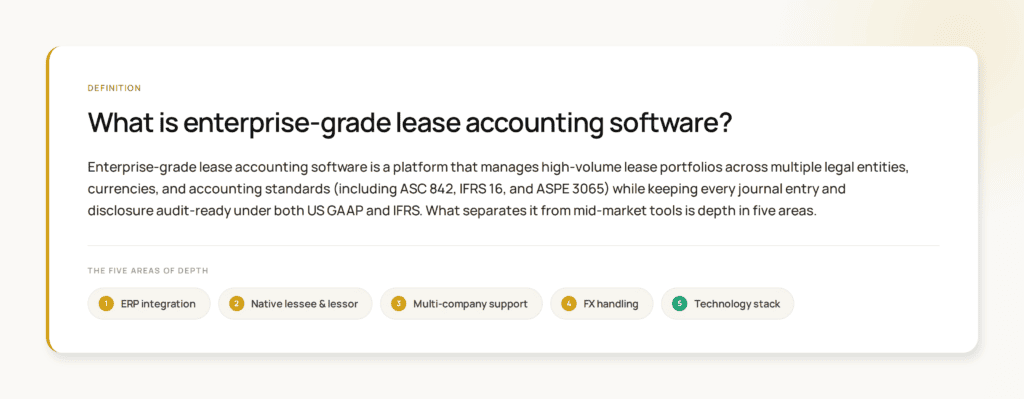
Enterprise lease accounting software is a platform that manages high-volume lease portfolios across multiple entities, currencies, and accounting standards (i.e., ASC 842, IFRS 16, and ASPE 3065) while keeping journal entries and disclosures audit-ready.
Beyond the basics of ROU assets and lease liabilities, it adds ERP integration, native lessee and lessor accounting, multi-entity consolidation, and standards-compliant foreign currency handling.
How is enterprise lease accounting software different from a standard ASC 842 tool?
A standard ASC 842 tool books a right-of-use asset and prints an amortization schedule for a single entity.
An enterprise platform adds multi-company hierarchies, multiple simultaneous standards on one lease record, FX remeasurement under IAS 21, native lessor accounting, and a real ERP integration into systems like SAP, Oracle, and NetSuite.
Which ERP systems should lease accounting software integrate with?
The most commonly requested integrations are SAP, Oracle (including NetSuite), Microsoft Dynamics 365, Workday, and Sage.
What matters is how it integrates, i.e., a native API is real-time and bidirectional, while a flat-file feed is a scheduled export. Ask the vendor to demonstrate a journal entry mapped to your own chart of accounts.
Does enterprise lease accounting software handle both lessee and lessor accounting?
The strongest enterprise platforms handle both in one system, including sales-type leases, direct financing leases, operating leases, the net investment in the lease, and lessor disclosures.
Many tools were built lessee-first, so lessor accounting is often partial or missing; i.e., confirm it on screen before shortlisting.
How should lease accounting software handle foreign currency?
Under ASC 842 and IFRS 16 (via IAS 21), the lease liability is remeasured at the closing rate, the ROU asset stays at the historical rate, and interest is translated at average rates — three treatments for one lease every month.
The software should also roll the effect into the cumulative translation adjustment at consolidation.
What security certifications should an enterprise lease platform have?
At minimum, SOC 1 Type 2 (controls over financial reporting) and SOC 2 Type 2 (security, availability, processing integrity), plus SSO via SAML, multi-factor authentication, role-based access control, and encryption in transit and at rest. Ask for current reports under NDA and check the report dates.

Greg Kautz
http://blackowlsystems.comGreg Kautz, CPA, CMA is a seasoned management consultant and professional accountant with over 40 years of experience in the consulting and energy sectors. At Black Owl Systems, Greg brings deep expertise in ERP systems, corporate finance, strategic planning, and technology integration.
